
Setting a floor price for surplus electronic components starts with your minimum retained amount and a clearly identified lot. Before you send a surplus list, connect each price to the complete part number, lot, quantity, packaging, currency, and costs. This guide shows you how to separate historical cost from a selling instruction, evaluate comparable offers, and decide when a partial order needs a revised price.
Separate the floor price from other prices
Keep these three figures in separate fields because they answer different questions:
- Historical purchase cost
- Minimum acceptable selling price
- Buyer's offer
An old purchase invoice can help document the stock, but it does not show what a buyer is prepared to pay for that lot now.
The floor is the amount you are prepared to accept for the stated goods and conditions.
- Price basis: Say whether it is a price per piece, per reel or for the complete line.
- Minimum quantity: If a minimum quantity applies, put it beside the price rather than in a note elsewhere in the file.
Do not present an asking price seen on a website as a completed transaction or a confirmed offer. Record the source, observation date, quoted quantity and conditions so the comparison can be checked.
Calculate an initial floor from your retained amount
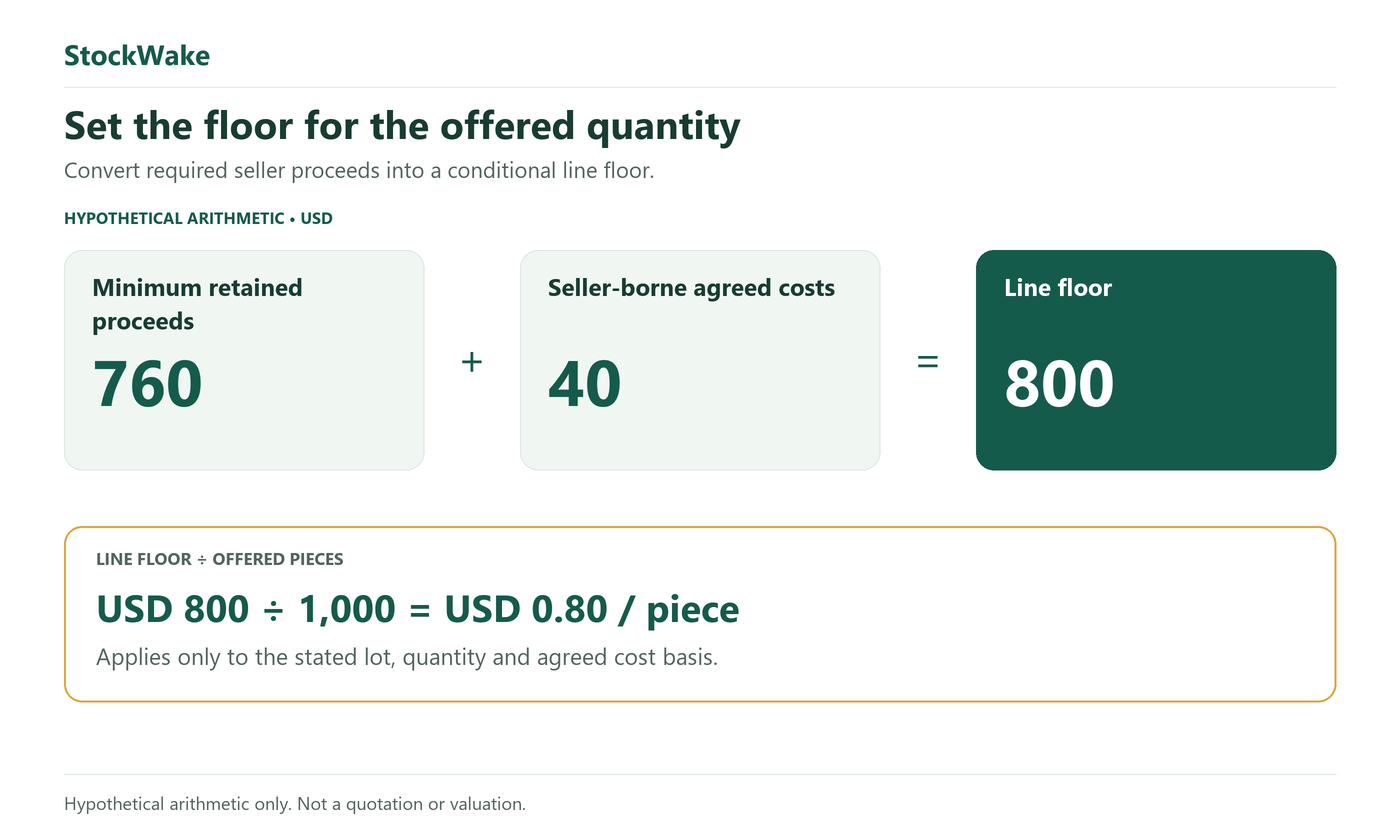
Hypothetical arithmetic: USD 760 retained proceeds + USD 40 seller-borne agreed costs = USD 800 line floor; divided by 1,000 offered pieces, the floor is USD 0.80 per piece.
Start with the minimum amount you are willing to retain for the identified quantity after the specified costs you have agreed to bear. This is an internal decision threshold, not a market valuation or a buyer's offer. Historical purchase cost can inform your decision, but it does not establish what the stock will sell for.
Use this sequence:
- Set the retained amount: Decide the minimum amount you are prepared to keep for this particular quantity and condition.
- Identify your agreed costs: Include the relevant packing, handling or transport costs only where the arrangement makes them your responsibility.
- Calculate the total floor: Add those costs to the retained amount. Do not include a cost twice or silently add a cost borne by another party.
- Convert the unit basis: Divide the total by the pieces covered, or state the corresponding identified reel or whole-lot amount.
The following calculation is fictional and compatible with Lot A in the later example. Assume you want to retain USD 760 and an agreed arrangement leaves you responsible for USD 40 of packing for all 1,000 pieces:
| Calculation | Illustrative result |
|---|---|
| Minimum retained amount plus agreed seller-borne packing | USD 760 + USD 40 = USD 800 |
| Total floor divided by the stated quantity | USD 800 / 1,000 pieces = USD 0.80 per piece |
| Equivalent basis for the identified full reel or whole Lot A | USD 800 for all 1,000 pieces |
The packing figure is an assumption for this illustration, not a standard charge or a StockWake fee. Record which costs your retained-amount calculation covers. The result is a starting instruction for discussion; whether any buyer accepts it remains a separate question.
Compare the offer's conditions before changing the number
A lower offer only becomes a useful comparison when it covers the same part, quantity and commercial basis. Ask which condition differs before deciding that your floor is too high. Use actual evidence for the offered stock, not the asking price of a superficially similar listing.
| What differs? | Question to resolve | Your decision |
|---|---|---|
| Quantity | Is the buyer taking the stated whole lot or requesting a smaller release? | Keep the existing instruction or calculate a separate partial-quantity floor |
| Packaging or documents | What presentation or evidence does the buyer require, and can you provide it? | Clarify feasibility before repricing |
| Agreed costs | Does the offer assume a different allocation of packing or transport costs? | Recalculate the retained amount on the same basis |
| Price only | Are the stock, quantity, evidence and cost assumptions otherwise comparable? | Keep your floor or issue a dated revision for that stock |
Keep the buyer's requirement, what you can substantiate and the unresolved points side by side. Stock outside a requested date-code range is not automatically defective; it may simply be unsuitable for that buyer. Likewise, a price reduction cannot produce missing documents or identify unknown material. Resolve those questions before using price as the response.
Decide what quantity the floor covers
A whole-lot floor should not silently become a partial-order price. Splitting a reel or a line can change the remaining stock, the package description and the costs that need agreement. State whether partial orders are acceptable and when a new price must be confirmed.
Use a piece count as well as a package count. "Two reels" is incomplete if their remaining piece counts differ. Do not describe a partial reel as factory-sealed unless the actual packaging and records support that description.
If several part numbers must be sold together, retain their line-level details. A bundle instruction should identify every included line and state how exclusions or quantity changes affect the proposal. It should not hide unidentified items inside a total value.
Worked example: a floor is conditional on the lot
The following figures are fictional arithmetic examples, not market quotations, available inventory or a valuation of any real part.
| Illustrative line | Quantity | Packaging | Illustrative floor | Quantity condition | Line value at that floor |
|---|---|---|---|---|---|
| DEMO-PART-01, Lot A | 1,000 pieces | One full reel; package condition recorded separately | USD 0.80 per piece | All 1,000 pieces | USD 800 |
| DEMO-PART-01, Lot B | 600 pieces | Partial reel; opened status disclosed | USD 0.70 per piece | All 600 pieces | USD 420 |
A buyer asking for 400 pieces has not automatically received a USD 0.70 or USD 0.80 offer. Neither line's stated quantity condition covers that request.
The seller needs to confirm which lot can be split, the package description after the split and the price basis for the resulting order.
Likewise, the two line values total USD 1,220 only for the stated quantities and assumptions.
That calculation does not establish a buyer's offer, a completed sale or the net proceeds of a transaction with different agreed costs.
Keep, revise or withdraw the instruction deliberately
Keep the existing floor when the buyer's request still matches its quantity, packaging and cost assumptions and you remain willing to accept that amount. Revise it when you deliberately accept a different retained amount or the agreed scope changes. If the proposed conditions cannot be supported, leave that offer unresolved rather than issuing a misleading price.
Save the previous version and identify the stock rows replaced by the revision. A changed price without its quantity condition can circulate as an apparent offer for stock you did not intend to split. Do not promise a recovery percentage or sale date based on the spreadsheet.
Keep the floor private when working with StockWake
Treat your floor as a private instruction to StockWake, not a price to disclose to the eventual buyer. Keep it separate from buyer-facing stock descriptions or documents. That distinction lets you discuss the offered selling price without confusing it with the amount you are prepared to accept.
StockWake's current seller model states:
When we find a buyer, we sell above your floor price — our margin is the difference, and we charge you no fees.
Prepare the identification fields using the surplus inventory list template, then attach the quantity and cost conditions for each floor. Flag missing information. The instruction should explain when StockWake needs to reconfirm a partial quantity or changed condition with you; submitting it is not an agreed buyer order.
Frequently asked questions
What is a floor price for surplus components? A floor price is the minimum amount you are prepared to accept for identified stock under stated conditions. Record the currency, quantity, unit basis, and cost exclusions alongside it. Keep it separate from historical purchase cost and a buyer's offer. If the lot, packaging, or quantity changes, reconfirm the instruction before treating the old floor as applicable to a new proposal.
Should I set the floor as a percentage of the original purchase price? No universal percentage converts an original purchase price into a suitable current floor. You can retain historical cost as a reference, but compare evidence for the exact part, quantity, packaging, and available documents. Distinguish asking prices from actual offers. If the evidence concerns different conditions or order sizes, resolve those differences before using it to support your selling instruction.
Can I use one price for several date codes? You can propose one price for several date codes, provided you keep the batch information visible. Record each lot, its quantity, packaging, and available documents in separate rows, then state which rows share the proposed price. The buyer still needs to accept the batch mix. Do not merge identifiers or assume a common price makes the lots interchangeable for the buyer's application.
Does a whole-lot floor apply to a smaller order? Only if your pricing instruction explicitly permits that quantity and packaging basis. A whole-lot floor does not automatically cover a smaller order, because splitting stock can change the remaining quantity, package description, and agreed costs. Before accepting the request, confirm which lot will supply it and whether the floor needs revision. Keep the revised instruction tied to the specific quantity being discussed.
What should I check if the stock is not attracting a suitable offer? First check whether the list identifies the exact parts, available quantities, packaging, and supporting records clearly. Then compare your quantity conditions and cost assumptions with the buyer's requirements. Missing documents or an unsuitable batch may need clarification rather than a price reduction. You can revise the floor when the evidence supports it, but a lower price cannot guarantee a sale or compensate for unidentified stock.
Final Thoughts
Set your starting floor from the amount you need to retain and the costs you have agreed to bear, then match it to the exact quantity and packaging. Keep that instruction private and revise it when the comparison justifies a change. You can send StockWake a surplus list with the part numbers, lots, quantities and price conditions, identifying what still needs confirmation before any buyer proposal becomes an order.
Sources
- StockWake Terms of Service, including the seller model and the distinction between listings and written order terms. Checked November 4, 2026.
- The pricing sheet and worked example in this guide are an editorial method and fictional illustration, not observed market-price data.
Editorial note: Prepared by StockWake using the published seller terms above. The pricing worksheet and numerical examples are editorial decision aids; hypothetical figures are not observed market prices or completed sales.