
Your BOM says "Single Source: XYZ Electronics." Your purchasing lead asks why. The honest answer is often that XYZ was the distributor who picked up the phone — not that they're the only one who can supply the part. Those are two very different situations. They call for two very different conversations, and they carry two very different risks.
Here is the distinction we walk buyers through, and the four checks that keep "single" and "sole" from being used as if they were the same word.
One means you chose. The other means you had no choice.
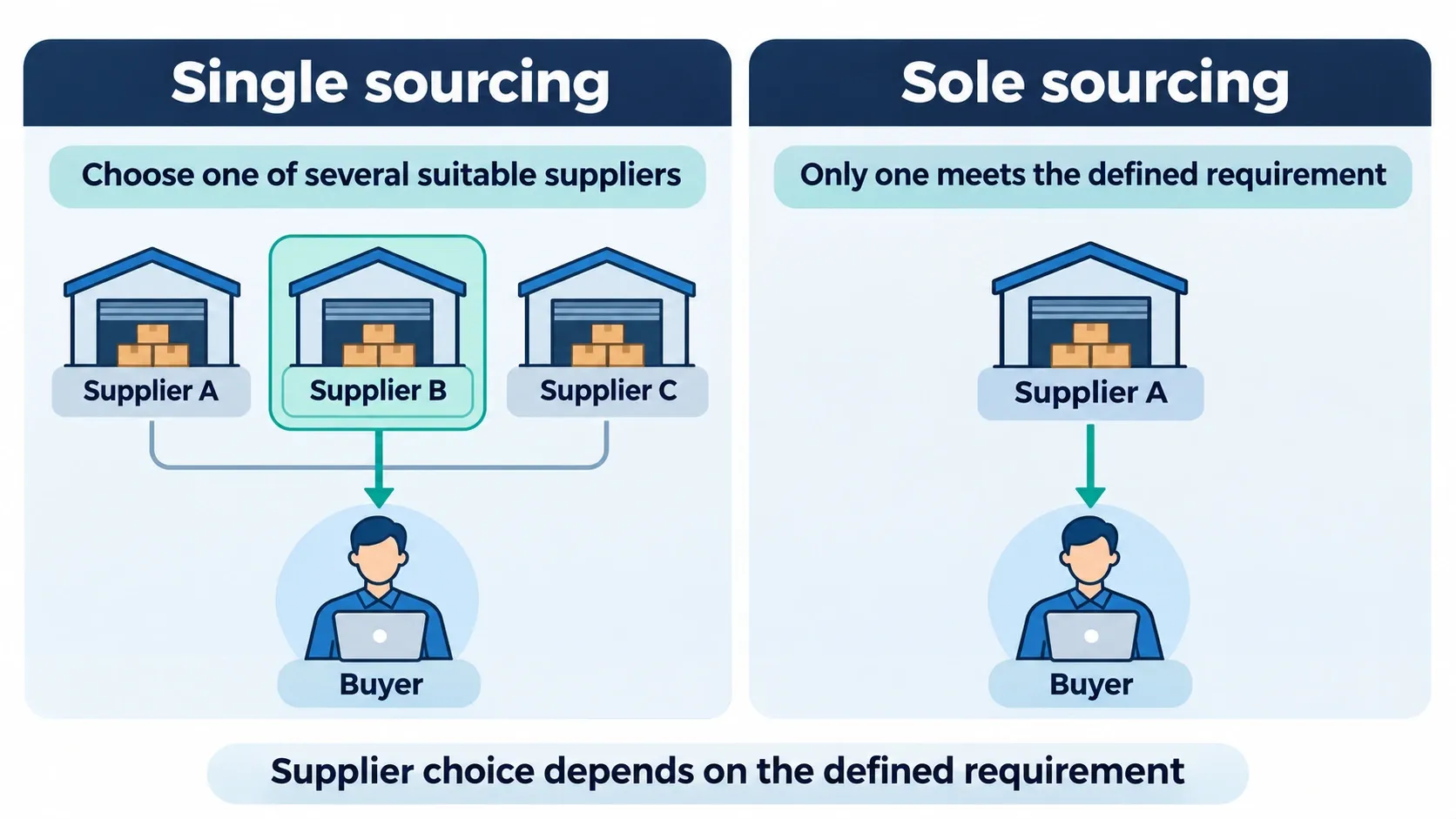
Single sourcing means you picked one supplier even though other suitable suppliers exist. Sole sourcing means only one supplier can meet the defined requirement — the market, the spec, or the approval record leaves you no alternative.
The starting point is whether a real choice exists. CIPS draws the line on exactly that basis: choosing one seller from several suitable sellers is a different situation from finding that only one seller can meet the requirement.
Before you apply either label, write down the requirement. For a component purchase, that usually means:
The complete ordering code
Approved technical requirements
Quantity and delivery date
Acceptable evidence
Keep the scope and the review date visible. A label without a defined requirement is a word, not a sourcing decision.
Single vs. Sole at a glance
Question | Single Sourcing | Sole Sourcing |
|---|---|---|
Do suitable supplier options exist? | Yes; one is selected. | Only one can meet the defined requirement. |
What needs explaining? | Why this supplier was chosen. | What prevents another supplier from meeting the defined requirement. |
What should be reviewed? | The selection and remaining options. | The constraint and whether it can change. |
One seller is not one source
This is the part that catches most buyers. A component can travel through several selling channels and still come from one manufacturer. That gives you seller choice without adding a manufacturing source. Review the four dimensions separately.
Manufacturer: the company that makes the specified device
Approved device: the ordering code permitted for the relevant design
Seller: the organization offering the material
Inventory: the identified physical quantity being offered
Then ask who actually holds that inventory. The stockholder is an organization. The inventory is material. A manufacturer's lot code is another identifier to check — but the lot code alone doesn't tell you who holds the units, and it doesn't tell you which physical quantity a given offer covers.
A second seller may offer a different quantity of the same device. A second manufacturer may require a different device and a technical review. A second approved code may open a design option while still being unavailable for this particular purchase.
The distinction between an independent distributor and a broker helps clarify the seller's role. But the role label itself doesn't establish ownership, availability, or independence of the quoted inventory.
Write the conclusion precisely. "Two sellers reviewed; one manufacturer; inventory independence unconfirmed" tells the next reader exactly what's open. "Two sources" does not.
Three quotes can still be one stockholder
Different seller names do not establish separate supply. Check the holder and the offered inventory as two separate questions.
Here's a pattern we see more often than you'd expect. Three sellers quote the same ordering code. A few phone calls later, all three offers turn out to depend on one upstream stockholder. A disruption at that holder hits all three offers at once. That's a shared upstream dependency — and it does not prove the three offers draw on the same inventory pool. Those are two different risks, and they need two different mitigations.
Ask each seller three questions:
Who holds the material being offered?
Is the quoted quantity reserved for this order?
Which details still depend on upstream confirmation?
Request evidence that connects the offer to the identified physical quantity. Review manufacturer lot codes separately. Different lot codes don't prove separate inventory pools. The same lot code doesn't prove two offers refer to the same physical units. Similar photos or similar quantities are worth a follow-up question — they are not a conclusion.
Where commercial confidentiality limits disclosure, record that limit. Holder dependency and inventory independence stay marked as unconfirmed when the evidence doesn't resolve them. That is a legitimate outcome, not a failure of the review.
The evidence decides the next move
Pick the next action after you've identified the constraint — not before.
Review dimension | Evidence to review | Unresolved constraint | Next action |
|---|---|---|---|
Seller | Suitability and purchase requirements | Only one seller has been checked | Evaluate other suitable sellers |
Inventory | Holder and offer-to-quantity linkage | Holder or inventory relationships remain unclear | Verify the holder and identified physical quantity |
Device | Exact code and design approval | Another device is only proposed | Request the relevant technical review |
Manufacturer | Approved manufacturing options | All approved supply depends on one maker | Assess whether another device or design is viable |
If the problem is seller choice, adding a technical substitute may be unnecessary work. If the problem is a manufacturing dependency, collecting more reseller quotes leaves that dependency exactly where it was.
Keep proposed substitutes separate from approved alternatives in the BOM sourcing request. Approval applies within its recorded scope. It does not establish current stock, capacity, or a confirmed delivery.
Carry the resulting constraint statement into the BOM sourcing request for hard-to-find parts. Include the required code, permitted options, and open questions. For each question, name the evidence needed, the purchasing or engineering owner, and the decision deadline. That's the difference between a note and an actionable next step.
Frequently Asked Questions
Can a sole-source position change over time?
Yes. Another supplier may meet the requirement, an additional device may be approved, or the purchasing requirement itself may change. Record what changed and reassess the affected dimension. A new company name alone does not establish a usable alternative.
Do two distributors count as two manufacturing sources?
Not necessarily. Two distributors may sell devices from the same manufacturer, from different manufacturers, or from a mix. Check the manufacturer behind each specific offer. Record seller choices and physical inventory options separately, and don't assume either one adds a manufacturing source.
Does dual sourcing always reduce supply risk?
No. The benefit depends on the risk being addressed and the independence of the sources. Two sellers drawing from the same inventory pool don't remove that inventory dependency. Define the benefit you're trying to get, then check whether the second source actually delivers it.
Does a supplier-suggested substitute count as a second source?
Treat it as a candidate until it meets the applicable technical and purchasing requirements. Keep its review status visible. Even an approved device needs a separate check of the actual offer before it becomes a usable purchasing option.
Which evidence supports choosing one supplier?
Keep the defined requirement, alternatives considered, selection reasons, unresolved dependencies, reviewer, and review date — with the evidence behind each entry attached. This is a decision record, not proof that supply will stay available.
Start with a defined requirement. Review the manufacturer, the device, the seller, and the inventory as separate dimensions. Establish the holder and the inventory relationship with evidence. Then decide whether to keep the selected supplier, open another channel, or evaluate a different device. When the requirement or the evidence changes, reopen the record.