
Two suppliers can offer the same obsolete part number without offering equivalent lots. You need to compare the material behind each offer: its identity, quantity, packaging, source records, and acceptance requirements. This guide helps you build a lot-by-lot comparison, distinguish date codes from lot identity, and decide whether several independently identified lots can form an acceptable purchasing plan.
Fix the part and your approved requirements
Lock the manufacturer and complete approved part number, including the required package, grade, finish and suffixes. A similar base number or an engineering suggestion is not approval to substitute another variant. Use the applicable manufacturer record to confirm part status, then compare the offered physical lots against that exact requirement.
State whether your approved purchasing requirement permits mixed lots, mixed date codes, partial releases and partial deliveries. If you purchase to a customer specification, obtain the required customer approval. These are separate decisions: one shipment can contain several lots, while one lot can be sent in several shipments. If whole-lot purchase is required, show the excess or shortage created by each combination instead of treating every quoted piece as something you need.
Compare three offers on a whole-lot basis
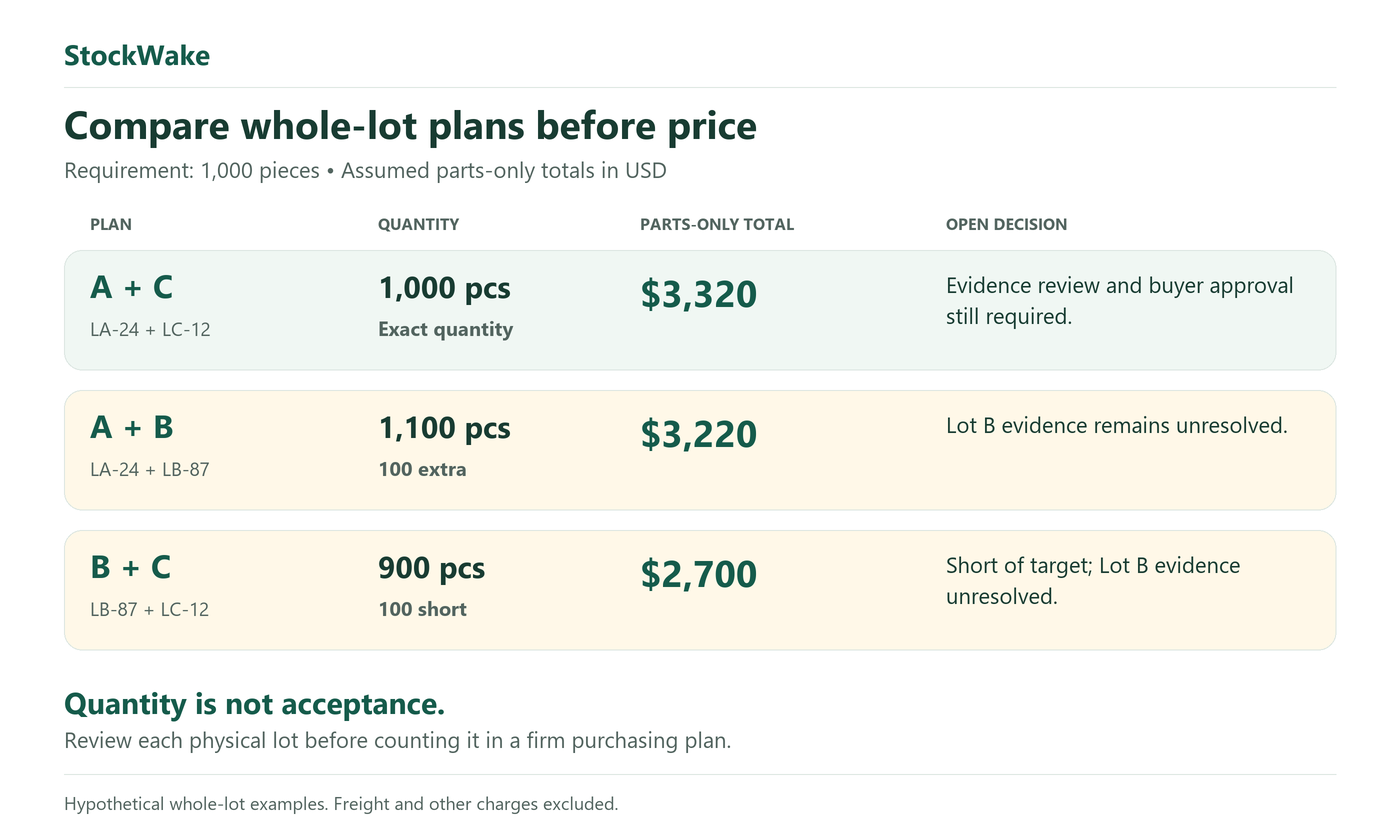
Hypothetical whole-lot comparison: A+C gives 1,000 pieces for USD 3,320; A+B gives 1,100 for USD 3,220; B+C gives 900 for USD 2,700. Quantity coverage does not establish lot acceptance.
The following is an illustrative purchasing scenario, not a customer case, available inventory or a current quotation. DEMO-EOL-64R-I is a fictional placeholder for one complete approved part number. Your requirement is 1,000 pieces. All prices are assumed USD per piece and exclude freight and other charges.
| Offer | Physical lot | Quantity | Date code as quoted | Unit price | Supplier-stated condition and evidence |
|---|---|---|---|---|---|
| Supplier A | LA-24 | 600 pcs | 2115 | $3.20 | Original sealed packaging; labels and source records supplied for review |
| Supplier B | LB-87 | 500 pcs | 2210 | $2.60 | Opened packaging; storage history and document-to-lot link unresolved |
| Supplier C | LC-12 | 400 pcs | 2115 | $3.50 | Original sealed packaging; labels and source records supplied for review |
Assume the quantities are separately identified physical stock. Different supplier names alone would not justify adding them. For the first comparison, also assume each offered lot must be purchased whole:
| Combination | Quantity bought | Parts-only total | Position against the requirement |
|---|---|---|---|
| A + C | 600 + 400 = 1,000 pcs | 600 x $3.20 + 400 x $3.50 = $3,320 | Exact quantity; two lots still need acceptance |
| A + B | 600 + 500 = 1,100 pcs | 600 x $3.20 + 500 x $2.60 = $3,220 | 100 pieces over the requirement; B's evidence unresolved |
| B + C | 500 + 400 = 900 pcs | 500 x $2.60 + 400 x $3.50 = $2,700 | Still 100 pieces short; B's evidence unresolved |
A + C gives you a 1,000-piece quantity plan costing $3,320. Its matching quoted date codes do not merge the two lots or establish that either meets your acceptance requirements.
A + B has a headline total $100 below A + C, but you would buy 100 extra pieces and the missing information for B still prevents a like-for-like purchasing decision. That price difference is not an executable saving. Resolve B's storage history and document-to-lot connection, then decide whether an overbuy is acceptable under the actual order conditions.
B + C has the smallest total but does not fill the requirement. You still need an acceptable source for the remaining 100 pieces. Do not assume you can take that quantity from A while the comparison requires whole lots.
Rebuild the comparison if partial releases are allowed
A supplier's agreement to split a lot changes the options; it does not automatically validate the old unit price for the smaller release. Ask which quantity can be supplied, what packaging will remain, and whether the price and other conditions apply to that selected quantity. Keep the supplier's response with the relevant lot reference.
Recalculate the plan using those confirmed quantities and prices. Preserve the whole-lot comparison as a separate scenario so the reason for any change remains visible. Do not compare the total for a full lot with the total for a partial release and call the difference a saving without explaining the different quantities.
Check the buyer's permission separately. A seller may agree to divide stock while the buyer still requires an unopened package or prohibits a proposed lot mix. Both conditions need to fit before the partial-release option can become your selected plan.
Decide what quantity the evidence supports
Create one evidence record per lot, linked to its full part number, identifiers and offered quantity. Keep quoted quantity separate from quantity accepted for the purchasing plan. If the buyer's acceptance covers only part of a quoted lot, record that limit instead of treating the whole offer as cleared.
Use the original manufacturer identifiers when interpreting date codes and lot codes. A supplier reference can help communication but does not replace the manufacturer's identity or explain a mismatch between inner and outer labels.
For B, request the specific missing storage and document-link information. For A and C, review the supplied labels and records rather than accepting the words "original sealed packaging" as proof. Record repacking, relabeling or split quantities where they affect the offered material.
For relevant moisture-sensitive devices, make the available exposure, resealing and storage information part of the lot's acceptance discussion. TI's controlled-storage guidance does not establish the history of independently held surplus stock. Use the applicable manufacturer instructions and the buyer's requirements, not a universal age cutoff or generic baking schedule.
Give each unresolved option its next action
Keep the arithmetic separate from the action needed to make a plan acceptable:
- A + C: Ask the two suppliers to confirm the identified lots, selected quantities, documents and current commercial conditions. Refer the proposed mixed-lot purchase to the responsible buyer or quality reviewer.
- A + B: Resolve B's evidence first. If it can be accepted, ask the buyer whether the excess quantity is justified and whether the whole-lot or a newly confirmed partial-release option should be evaluated.
- B + C: Resolve B's evidence and keep the shortage visible. Request the remaining exact part and quantity without implying the existing offers already provide complete coverage.
An unanswered question is neither a passed check nor proof of a defective part. Record who must answer it and what decision depends on that answer. This avoids treating a cheaper conditional option as an order-ready substitute for an identified, reviewed plan.
Date the comparison and record the quotation versions. If a supplier changes a quantity, withdraws a lot or proposes different packaging, reopen the affected combination. Keep the previous version so a new offer is not silently treated as the same purchasing decision.
Carry the selected lots into the order and receiving record
Before committing, agree the required documents, inspections or tests for each lot, the reviewer and the handling of unresolved findings. A report must identify its samples, method and scope; testing a sample does not mean every untested piece was individually examined.
Compare the selected plans using their actual quantities, price breaks, currency, freight and delivery conditions. With an overbuy, also decide whether the extra quantity has an approved use; a lower goods total alone does not make that stock necessary. For a short plan, leave the cost of the missing material unresolved until you have an acceptable offer.
Put the selected lot references, quantities, approved mix and document package into the order and packing instructions. Ask who will preserve lot identification if material is repacked or divided. When receiving it, reconcile the shipment with those instructions before combining it with other stock. Keep any mismatch visible for the responsible team's decision rather than assuming a particular defect or return remedy.
Frequently asked questions
Do matching date codes mean that two offers are the same lot? No. A date code alone does not establish that two offers refer to the same physical lot or owner. Compare the complete manufacturer part number, manufacturer lot identifiers, quantities, and source records. Ask suppliers to explain how the offered material is identified. Keep each offer separate until you understand whether the quantities are independent, overlapping, or simply different quotations for the same stock.
Should I automatically choose the most recent date code? No. Start with your approved date-code requirements, then compare the available evidence for each lot's packaging, storage, and source history. A more recent marking does not establish better condition, just as an older marking does not establish failure. Record unknowns clearly and refer unresolved acceptance questions to the responsible buyer or quality team instead of using age alone as the decision rule.
Can several lots satisfy one obsolete-part requirement? Several independently identified lots can form a quantity plan for one approved part number. You still need to confirm that the buyer accepts the proposed mix and that each lot meets the agreed identity, documentation, condition, and delivery requirements. Preserve separate lot records through ordering and packing. Combining quantities does not combine their evidence or turn a proposed allocation into a confirmed, acceptable shipment.
Can one test report cover all offered lots? Possibly, but only within the report's stated scope. Check the identified samples and lots, the test method, the quantity covered, and the relationship between the tested material and each offered lot. A report for one lot does not automatically cover another with the same part number or date code. If the connection is unclear, request clarification before using the results in your acceptance decision.
What should I do when a supplier cannot provide a storage record? Record the missing history and ask what alternative records are available, such as packaging evidence, source documents, or exposure and resealing information for relevant moisture-sensitive devices. Keep any remaining uncertainty visible. The responsible buyer or quality team should decide whether the evidence and proposed checks meet the application's requirements. Do not describe the storage history as verified simply because the supplier cannot provide it.
Final Thoughts
Choose a lot combination only after comparing what it supplies, what it costs and which evidence gaps remain. In the example, other combinations change the quantity balance and depend on B's unresolved evidence, rather than simply replacing A plus C at a lower price. When you send StockWake a sourcing request, include the full part number, quantity, lot-mix and packaging restrictions, and any conditions requiring approval before ordering.
Sources
Editorial note: Prepared by StockWake using the named manufacturer and distributor sources. The comparison methods and checklists are editorial analysis; labeled hypothetical examples do not describe an actual order.