
A solderability report lands on your desk. The summary line reads PASS. Before you forward it to the quality team, ask three questions: what surface was tested, which lot did the samples come from, and what method produced that pass? The answers change what the PASS actually means — and none of them are guaranteed to be in the report.
Solderability testing evaluates how a component's intended soldering surfaces accept solder under defined conditions. That is all it evaluates. It can tell you whether the offered material meets a solderability requirement. It cannot, on its own, tell you whether the part works, whether it is genuine, or whether it will survive your reflow profile. Connecting those answers to the exact lot being offered is the buyer's job — and this is how we do it.
It tests the termination, not the part
The first question is whether the surfaces intended for soldering wet as required by the chosen method. Identify those surfaces before you discuss a result. A component's terminations and a printed board's pads are two different test objects, and a report for one cannot stand in for the other.
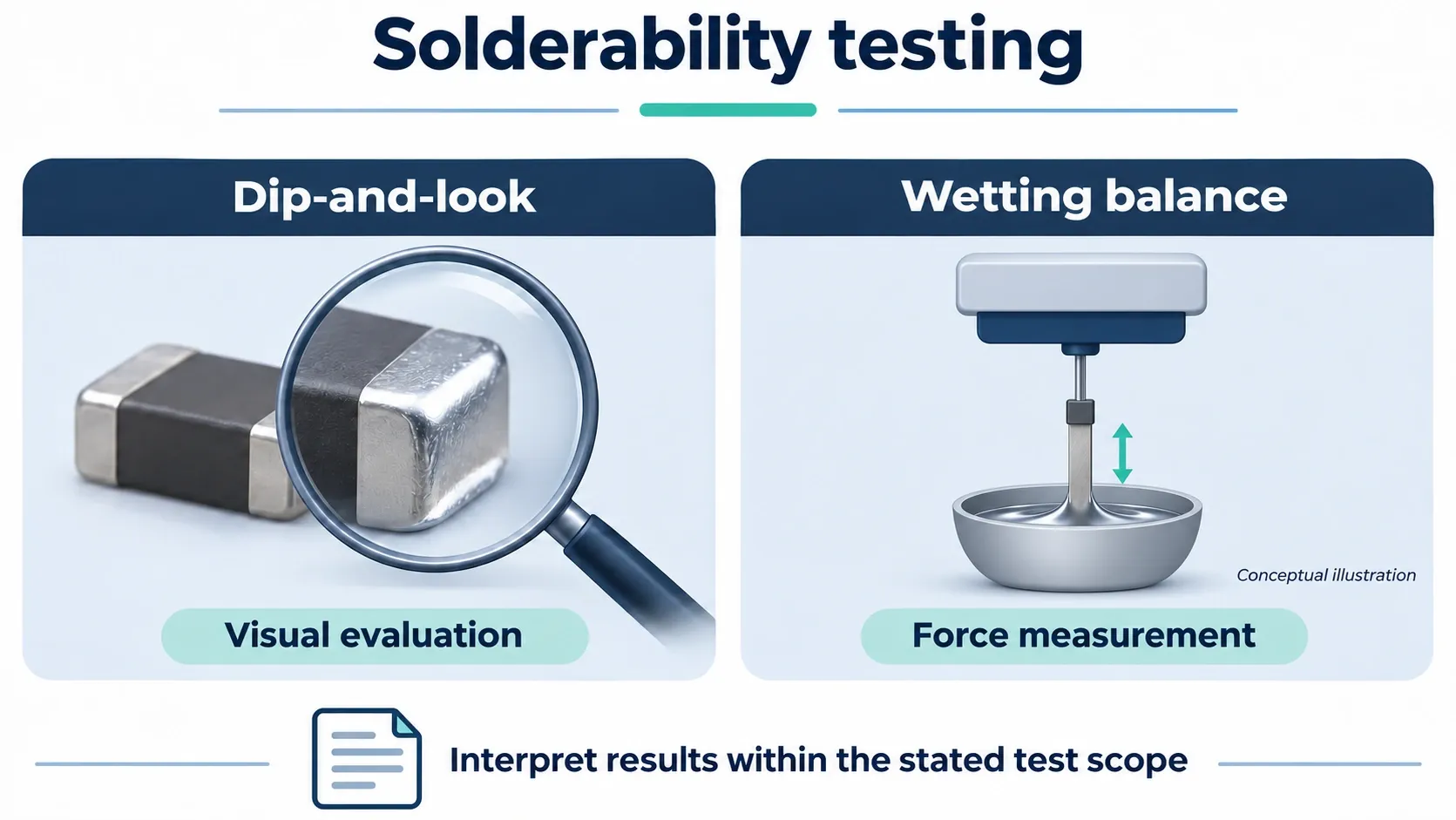
The public J-STD-002E excerpt covers component leads, terminations, and related items. Its methods include visual evaluation and force measurement. J-STD-003 covers printed boards. A report on board surface wetting is not a test of the offered components — no matter how similar the surfaces look on paper.
For purchasing, write the open question in plain language. You might need, for example, evidence about the solderability of a specific lot with incomplete storage records. That's a review question, not a finding that the lot is defective. Establish the object and the concern first. Then pick a method.
The method follows the component and the question
Dip-and-look and wetting-balance produce different evidence. The reviewer should choose the method based on the package, the soldering surfaces, and the specific question being investigated. A familiar test name is not enough — the same "solderability test" label can describe three different measurements.
ST's 2004 AN2036 application note shows dip-and-look and wetting-balance outputs side by side. Its stated test conditions belong to the context described in that note, not to every package on your BOM.
Method | Typical evidence | Interpretation boundary |
|---|---|---|
Dip-and-look | Visual observations after the specified solder exposure | Apply the selected method's preparation and visual criteria |
Wetting balance using a solder bath or globule | Force measurements recorded during wetting | Use the scope and evaluation basis specified for the selected bath or globule procedure |
Solder-paste wetting balance under IEC 60068-2-83 | Comparative wetting data for SMD terminations | Do not turn these data into absolute quantitative pass/fail values |
That last row matters. The official summary of IEC 60068-2-83:2025 describes a comparative method using solder paste. The limitation belongs to that method. It is not a claim that every wetting-balance method lacks acceptance criteria.
Agree on the applicable specification, edition, and evaluation basis before work starts. The public excerpts cited here explain scope — they are not a complete test procedure. For organizing the proposed work, use the component inspection request guide. And don't copy temperatures, exposure times, or sample counts from an unrelated report, however close the package looks.
A report only counts if it matches the lot
A useful report connects the actual specimens to the material under review. Different lots stay separate when their identities or histories differ. A matching part number alone does not show that the reported samples came from the offered stock.
Use the following as a buyer's review checklist — not as an exhaustive reporting template that every standard imposes.
Report item | Review purpose | Action if unclear |
|---|---|---|
Exact part, lot, and sample references | Connect the specimens to the offered material | Request the missing association records |
Method, edition, and tested surfaces | Establish what the work evaluated | Ask which procedure and scope were used |
Preparation and actual test conditions | Interpret the result under its stated conditions | Request the relevant recorded conditions |
Observations, measurements, and evaluation basis | Understand the finding and any stated pass | Seek the result details and supporting criteria |
Sample selection and population covered | Understand the basis for any lot decision | Refer the coverage gap to the quality reviewer |
Read the observation records behind a summary that says only "pass." If photographs support visual findings, ask how they identify the tested surfaces and specimens. For the wider document question, the guide to CoCs and inspection and test reports explains the different records. Here, the task is narrower: establish what this solderability result actually supports.
A PASS has a boundary
A pass means the stated result met the stated criteria within the evaluated scope. It does not mean every purchasing question has been answered.
Electrical function needs evidence for the required electrical characteristics.
Authenticity needs a separate sourcing and identity review.
A lot decision needs an appropriate sampling and acceptance basis.
Actual assembly performance needs its own review of the intended process.
Keep those decisions separate even when one laboratory performs several of them. A solderability result can be useful without being sufficient for final acceptance. Record which requirement it addresses and which requirements remain open.
If the concern is authenticity, use the counterfeit component risk guide to frame that separate review. Do not relabel a limited wetting result as comprehensive component qualification.
Turn the finding into the next action
The responsible reviewer can work through these checks in order:
Confirm relevance. Match the samples, surfaces, and conditions to the requirement under review.
Resolve interpretation gaps. Ask for missing results or criteria before relying on a summary.
Address any unmet criterion. If a criterion is not met, keep the affected acceptance decision open and refer the finding for disposition.
Assign further action. Identify the unresolved requirement and who must address it.
Do not switch test methods simply to obtain a more favorable label. Any further work should answer the unresolved question under an approved scope.
FAQ
What is the difference between solderability and functional testing?
Solderability testing evaluates soldering surfaces under a defined method. Functional testing checks specified electrical behavior. One result cannot replace the other. If electrical characteristics matter to the purchase, state them and their conditions separately.
Does an old date code automatically mean poor solderability?
No. A date code alone does not report the present condition of the soldering surfaces. Review the available storage and handling information, the component requirements, and the unresolved risk. Let the responsible reviewer decide whether solderability testing is needed.
How do dip-and-look and wetting-balance tests differ?
Dip-and-look uses visual evaluation after specified solder exposure. Wetting-balance methods record forces during wetting. They provide different evidence about solder wetting. Choose the applicable procedure and evaluation basis — don't treat the method names as interchangeable.
What should a solderability test report identify?
For buyer review, seek the part and sample identities, the lot association, the method and edition, the preparation, the conditions, the findings, and the evaluation basis. Clarify the population covered by any acceptance statement. The applicable procedure may require additional information.
Does passing solderability testing prove a component is genuine?
No. A solderability result concerns the tested surfaces and method. It does not establish the component's origin or full identity. Keep source documentation and any required authenticity checks in a separate review, linked to the same offered material.
Keep a review record that identifies the offered lot, the report reference, the finding used in the decision, and the material covered. Add the decision owner and any outstanding action. That way the next reviewer can see what was decided, on what evidence, and what still needs resolution.