
When you buy surplus components, a document is useful only if you can connect it to the parts being offered. A certificate of conformance (CoC), an inspection report and a test report provide different kinds of evidence. You need to check who issued each record, which lot it covers and what it actually supports. Start with the evidence your purchase requires, then decide whether the offered records address it.
Compare what the documents actually support
Document names and formats vary. Read the statement and scope rather than assigning a fixed level of assurance to a heading.
| Document | Question it can help answer | What to examine | Important limit |
|---|---|---|---|
| Manufacturer or distributor CoC | What conformance statement is the issuer making for identified goods? | Issuer, specification or order reference, part identity, quantity and approval | It may not include individual measurements or a separate independent test |
| Outgoing inspection report | What checks were performed before shipment? | Inspected items, method, sample quantity, observations and disposition | It supports only the activities and material within its stated scope |
| Test report | What results came from the stated test procedure? | Sample identity, method, conditions, criteria, results and approval | You must interpret the results against the tested scope and sampling basis |
These records can complement one another. An inspection report should not be renamed as a manufacturer CoC, and a laboratory report does not automatically establish an unbroken supply history. A document title or a "pass" result is not, by itself, proof of every component's condition or authenticity.
Turn a document gap into a purchase decision
Decide what the missing information prevents you from approving. Asking for "more certificates" gives the supplier little direction and can produce extra files without resolving your actual requirement.
The following are illustrative review situations, not actual supplier findings:
| Your requirement and the offered evidence | What remains unresolved | Next step |
|---|---|---|
| A manufacturer-issued CoC is required, but only a distributor CoC is offered | The required issuer is missing | Seek the required record or an authorized change to the requirement |
| A report identifies the part number but does not connect it to the offered lot | The document-to-goods connection | Request records identifying the material covered before relying on the report |
| An electrical characteristic matters, but the report describes packaging inspection only | The requested property has not been evaluated by that report | Request applicable evidence or refer the unmet requirement to your reviewer |
| References match and the scope addresses your requested checks | The evidence is ready for assessment | Send it to your purchasing or quality reviewer; do not treat readiness as acceptance |
If the required record is unavailable, decide whether to seek another offer or request an authorized change. A supplier's willingness to provide a different document does not change your requirement. Keep that decision separate from negotiating the component price: a discount does not supply missing evidence.
Match the issuer and the goods before reviewing results
Compare the quotation, package labels, shipment references and document identification. Start with the complete manufacturer part number, including relevant suffixes. If the supplier uses an internal number, obtain a clear cross-reference instead of assuming two similar descriptions identify the same device.
Then check quantity and available lot identifiers. Keep a separate evidence entry when a different lot or packaging operation changes the records you are reviewing. One folder for a part number can hide the fact that its files describe several different batches.
As one first-party example, Avnet's published purchase-order requirements lists purchase-order, quantity, date/lot-code and conformance-statement information among its supplier CoC requirements. These are Avnet's requirements, not a universal template for every order. Use them to understand why references matter, while defining your own required package through the purchasing process.
Identify the issuer's role. A manufacturer, distributor, other seller and independent laboratory are different sources of evidence. A logo alone does not establish authorization or identify everyone who handled the goods. If the issuer is unclear, resolve that question before interpreting the document as a statement from a particular organization.
Read the scope before accepting a result
For an inspection report, establish what was inspected and what the activity could establish. An identification and packaging check answers different questions from an electrical test. Photographs are useful only when you can tell which samples or packages they show.
For a test report, read the method, conditions, applicable specification or criteria, results and approval. Find the sample count and how the samples relate to the offered lot. Do not convert a sampled result into a statement that every unit was individually tested.
Ask a focused question when the scope is incomplete. For example, if your requirement concerns an electrical parameter, identify that parameter and ask where the report evaluates it. An unrelated "pass" is not an answer. Your reviewer can then decide whether the available scope is adequate or whether a different evaluation is needed.
Record the reason for any unresolved decision. "Scope does not address the required parameter" is more useful than "documents incomplete": it tells your colleague and the supplier exactly what must change. It also prevents an unrelated replacement report from being accepted merely because it has a different title.
Preserve the connection when a lot is split
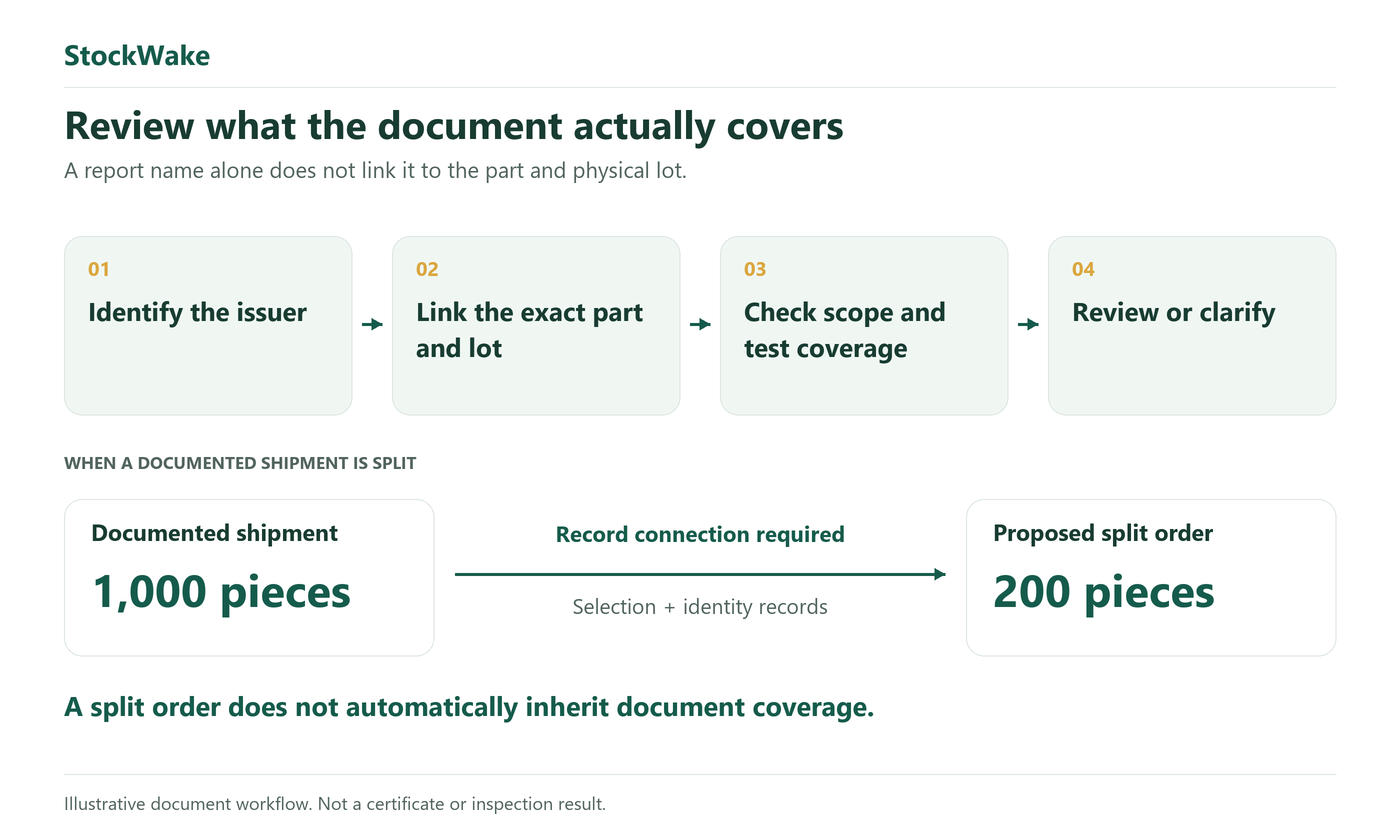
Illustrative review sequence: identify the issuer, link the exact part and lot, check scope and test coverage, then review or clarify. A 200-piece split order needs records connecting it to the documented 1,000-piece shipment.
Consider this fictional quantity example:
- Original shipment: A document identifies 1,000 pieces.
- Proposed order: You are offered 200 pieces taken from that shipment.
The difference can have a legitimate explanation. It still needs a record connecting the original document reference and source package to the new order line. Ask how the pieces were selected and identified, and whether any relabelling, repacking or combination of lots occurred.
A second spreadsheet carrying the same part number is not enough if it provides no way to identify which source quantity supplied your order. You should be able to follow the explanation from the original reference to the source package and then to the offered quantity. Keep the supporting records with that explanation rather than retaining only a summary assertion.
Distinguish a split shipment from a sampling statement. A declaration covering an original shipment and a report describing tested samples answer different questions. Neither should be silently extended to a different quantity without understanding its scope and connection. If the link remains unexplained, keep that order line unresolved.
DigiKey's traceability guidance notes that manufacturers use their own coding rules. Matching short codes alone do not replace the complete part and shipment record. Refer to date codes and lot codes when interpreting those markings, while retaining the other identifying references.
Agree the document package and review timing
State the required records when requesting a quote. Name the issuer and scope you need instead of asking only for "certificates." Separate documents required for your purchasing decision from records expected with shipment, and agree how unavailable items will be identified.
Document availability can depend on the original purchase route. TI's CoC FAQ describes retrieving CoCs for eligible orders through its own ordering system. DigiKey states that it can supply a manufacturer CoC if the manufacturer has made it available. These are specific supplier arrangements, not a promise that every secondary-market lot has the same records.
Have the quotation identify the package applicable to the offered lot. If the supplier proposes an inspection or test, clarify the intended scope before treating it as the answer to your requirement. Keep the required package and the supplier's stated availability side by side so missing items remain visible.
Before order confirmation, name the person responsible for reviewing any exception. An unanswered request is not an approved exception. If that reviewer accepts a revised requirement, retain the decision with the order; do not make receiving staff reconstruct it from an earlier email discussion.
Keep the agreed evidence with the receiving record
Carry the agreed document references into the order and receiving instructions. On arrival, compare the shipment identifiers and quantities with that record. A changed package or different reference needs reconciliation rather than automatic acceptance because the base part number matches.
If a discrepancy appears, identify whether it concerns missing paperwork, lot linkage or the actual inspection scope. Direct it to the responsible reviewer and keep the line's status visible. This preserves the purchasing decision without turning an unexplained difference into either a passed check or a claim that the material is defective.
Frequently asked questions
Is a CoC the same as a test report? No. A CoC records a conformance declaration, while a test report records an identified test scope and results. A CoC may refer to testing without including the particular measurements or report your order requires. You should review the issuer, part and lot references, and the scope of each record. Confirm the document package against your purchasing requirements before you approve the order.
Does an outgoing inspection report prove every part is authentic? No single report should be treated as proof of every component's authenticity without reviewing what it covers. Check the activities performed, the sample basis and the identified lot. You should also confirm how the checked items relate to the goods you are buying. Decide whether that evidence meets your agreed acceptance requirements and clarify any remaining verification needs before proceeding.
Can a distributor CoC replace a manufacturer CoC? If your order explicitly requires a manufacturer-issued CoC, a distributor CoC does not meet that requirement unless the authorized decision maker changes it. It may still provide useful evidence, but its issuer and statement remain different. Check what is available for the identified lot before committing. If no acceptable substitution is approved, seek another offer instead of treating the records as interchangeable.
What if a report covers a different quantity? Ask the supplier to explain how the documented or tested quantity relates to the quantity offered to you. A split shipment or sampling plan may account for the difference, but the records should identify the goods covered and the conclusions that apply. You should retain the link between the original lot, any repacking or relabelling, and the items on your order.
Should documents be requested before payment? State your required documents and review timing when you request a quotation, before you confirm the order. Identify which records must be available for your purchasing decision and which are expected with the shipment. If a record is missing, ask whether it exists and how the gap will be resolved. You should not assume that an unavailable document will automatically appear after payment.
Final Thoughts
Before you approve a component order, match the required documents to the exact part number, lot and agreed acceptance criteria. Record any gaps and decide whether they require clarification, another offer or an authorized requirement change. You can include those requirements in a StockWake BOM or sourcing request so the quotation can identify the applicable document package. Keep the agreed records available for receiving checks.
Sources
- Texas Instruments: Certificates of Conformance for online orders.
- DigiKey: Quality standards and traceability.
- Avnet: Purchase Order Flowdowns, Quality Compliance and Certificate of Conformance.
Editorial note: Prepared by StockWake using the named manufacturer and distributor sources. The comparison methods and checklists are editorial analysis; labeled hypothetical examples do not describe an actual order.