
A low quotation total can hide the lines your production plan still needs. When suppliers quote only part of your bill of materials (BOM), compare selected quantities against one current requirement list rather than adding every offer together. This guide shows you how to identify shared stock, hold unapproved alternatives outside coverage, calculate the remaining gaps, and compare the cost of the purchasing plan you actually intend to place.
Use one current requirement and one quantity basis
Use one approved requirement as the baseline for each supplier's BOM quotation.
Give each line a stable ID, manufacturer, complete orderable part number, quantity in pieces and required delivery date. Attach packaging, date-code, document and alternative-part restrictions where they affect acceptance. Consolidate repeated lines only when those requirements match, keeping the original references.
Begin with the quantity still needing procurement after the receipts and firm orders already recorded in your system. Keep quoted offers, your selected plan and subsequent order records distinct, but do not build parallel totals that count the same units twice. If an approved requirement changes, date the revision and identify the lines it replaces.
The comparison below measures a remaining RFQ gap, not the unreceived balance of an existing purchase order. A selection is a purchasing plan, not a stock reservation or a confirmed order.
A worked example with two partial quotations
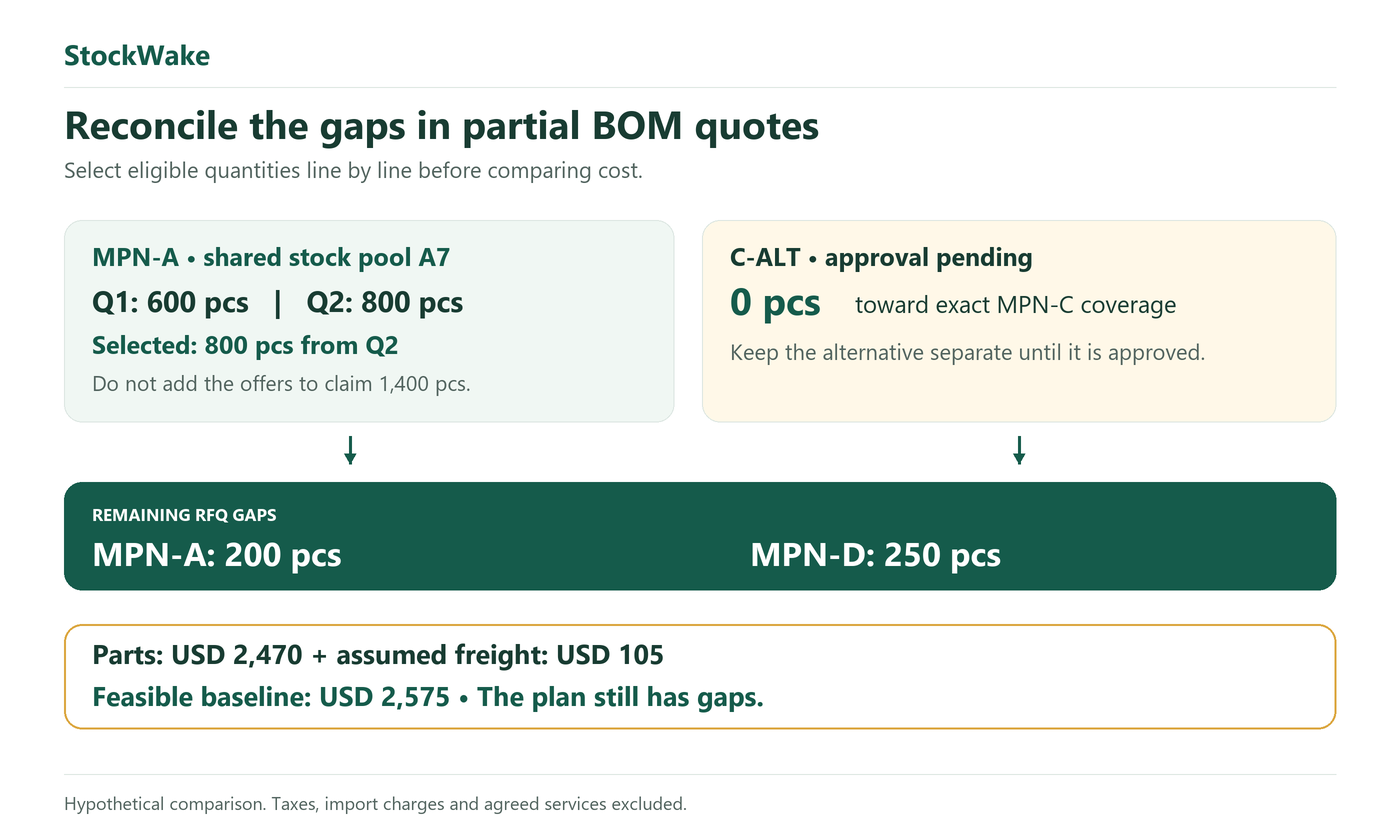
Hypothetical BOM reconciliation: do not double-count pool A7 or count unapproved C-ALT as the exact part. The remaining RFQ gaps are 200 MPN-A and 250 MPN-D pieces. A feasible baseline of USD 2,470 in selected parts plus USD 105 assumed freight totals USD 2,575; it is not a minimum-cost claim.
The following example is entirely hypothetical. MPN-A, MPN-B, MPN-C and MPN-D are fictional placeholders for complete approved part numbers, not real products or stock offers.
All prices are assumed USD per piece and remain applicable to the selected quantities. Shipping is considered separately.
| Line | Net requirement | Quote Q1 | Quote Q2 | Selected quantity | Remaining RFQ gap |
|---|---|---|---|---|---|
| MPN-A | 1,000 pcs | 600 pcs at $0.80; pool A7 | 800 pcs at $0.75; same pool A7 | Q2: 800 pcs | 200 pcs |
| MPN-B | 2,000 pcs | 1,500 pcs at $0.10 | 2,000 pcs at $0.12 | Q2: 2,000 pcs | 0 pcs |
| MPN-C | 400 pcs | 400 pcs of C-ALT at $2.10; approval pending | 400 pcs of exact MPN-C at $2.50 | Q2: 400 pcs | 0 pcs |
| MPN-D | 800 pcs | 250 pcs at $1.20; pool D1 | 300 pcs at $1.10; independent pool D2 | Q1: 250 pcs plus Q2: 300 pcs | 250 pcs |
- MPN-A: shared stock pool. In this example, the sellers have explicitly confirmed that both MPN-A offers refer to the same underlying 800-piece stock pool. Their quantities cannot be added to claim 1,400 pieces.
- MPN-D: independent stock pools. The MPN-D pools are assumed separately identified and available for split purchasing, so their selected quantities can be combined.
For each line:
Remaining RFQ gap = max(net requirement - selected eligible quantity, 0)
The plan fully covers two of four lines. The remaining gaps are:
- MPN-A: 200 pieces.
- MPN-D: 250 pieces.
Adding unlike components into one overall piece-count percentage would hide these shortages.
Recalculate the selected cost
This baseline is a feasible quantity plan on the stated assumptions, not a claim of minimum cost. Selected parts total $2,470:
- MPN-A: $600.
- MPN-B: $240.
- MPN-C: $1,000.
- MPN-D: $630.
Assuming final freight of $40 for Q1 and $65 for Q2, the comparison subtotal is $2,575.
This excludes any applicable taxes, import charges or separately agreed services.
Q1's eligible exact-part lines alone total $930 before freight. That smaller figure does not make it a more complete solution.
Its C-ALT offer is a separate, unapproved option; it contributes zero to exact MPN-C coverage. Likewise, Q2 alone costs less than the combined plan because it supplies fewer MPN-D pieces.
Test a cheaper split on MPN-B without calling it guaranteed savings
The baseline is feasible on its stated assumptions, but it is not a demonstrated minimum-cost plan. MPN-B illustrates why you should test the selected allocation rather than compare only full quotation totals.
If the two B offers are confirmed to be independent stock, split purchasing is permitted, and both unit prices apply to the selected releases, another allocation could be:
| MPN-B option | Parts-only calculation | Covered quantity |
|---|---|---|
| Baseline: Q2 alone | 2,000 x $0.12 = $240 | 2,000 pcs |
| Conditional split | Q1: 1,500 x $0.10 + Q2: 500 x $0.12 = $210 | 2,000 pcs |
The conditional goods difference is $30. Before selecting it, confirm that Q2 will release the smaller quantity at the assumed price, that the material meets the same requirements, and that neither supplier is quoting overlapping stock.
Then check the actual freight and any agreed handling changes. Q1 already supplies part of MPN-D in the baseline, so neither an extra freight charge nor free consolidation should be assumed for adding B. Obtain the commercial basis for the shipment you would actually place.
Keep the original $2,575 baseline unchanged as the reference scenario. Record the split as a separate option until its quantities, prices and commercial consequences are confirmed; a lower goods figure alone does not establish the lowest complete purchasing cost.
Route each kind of open issue to the right person
Not every incomplete line needs another broad sourcing request. Classify the reason it remains open and send a question to the party able to resolve it:
| Issue | Immediate owner and action | What stays out of counted coverage |
|---|---|---|
| Confirmed quantity shortfall | Send the remaining exact quantity and requirements for sourcing | Quantities not supported by a selected eligible offer |
| Underlying stock overlap unresolved | Ask the suppliers to identify whether the offers are independent or refer to the same stock | Potentially duplicated quantities until the overlap is resolved |
| Alternative approval pending | Send the proposed full part number and supporting information to the authorized buyer or engineering reviewer | The unapproved alternative |
In the worked example, A's shared pool is already confirmed; do not reopen it as an unanswered question. Its remaining quantity is 200 pieces. D's independent selected pools provide 550 pieces against an 800-piece need, leaving 250 pieces to source.
C is covered by the selected exact MPN-C offer from Q2. The C-ALT proposal remains an unapproved option, but it does not create an additional shortage once the exact-part plan already covers the requirement. Do not count that alternative as another supply of the same requirement either.
Keep each issue attached to the line ID, quotation revision and current decision. When an answer changes the option, replace its previous state rather than adding a fresh quantity as if it were another stock source.
Compare the commercial basis of the selected quantities
Check whether each price is per piece, per 100 pieces, per reel or per lot. Minimum releases, packaging quantities and price breaks can change when you select less than the full quoted amount. Ask for the price that applies to your actual release, not simply the lowest displayed tier.
Keep the original currency visible. If you use a common currency for comparison, record the exchange-rate source and date; it does not change the supplier's payment currency. Separate goods, freight and other stated charges, applying shipment costs once to the shipment they cover.
DigiKey's quotation guide distinguishes stock at quotation time, the balance still to arrive, packaging, minimum release and pricing validity. Use the definitions on the supplier's own quotation. Confirm what the selected part, quantity, packaging and delivery plan would actually cost before treating the scenario as comparable.
This is also where you resolve a changed quotation. Recalculate the selected plan when the supplier changes its quantity or price basis, while retaining the earlier revision as history rather than additional supply.
Send a follow-up request that can be acted on
For a confirmed quantity shortfall, send the unchanged line ID, full part number, remaining quantity, required date and acceptance restrictions. Identify what is already selected or ordered. That lets the recipient quote the open need without repeating a quantity already covered elsewhere.
For unresolved overlap, ask a precise stock-identity question instead of circulating both offers as additive availability. For an alternative, send an approval request with the proposed part number and the relevant requirements; a request for a lower price cannot substitute for that technical decision.
Before ordering, reconcile the final supplier confirmations to the approved requirement and record which option you selected and why. If a condition remains unresolved, keep it visible. Do not present a quantity-complete spreadsheet as proof that every commercial, documentation or acceptance question has been closed.
Frequently asked questions
Can I add quantities from two supplier quotes for the same part? Only when the underlying stock is independent, the selected quantities meet your current requirement, and split purchasing is acceptable. Two suppliers can quote the same owner's inventory, so their offers are not automatically additive. Record the quotation revision and available stock identifiers, then resolve any overlap before counting coverage. A selected quantity remains a plan until the supplier confirms the particular order and allocation.
Should a cheaper alternative count as coverage? Not while approval is pending. Keep the proposed full part number, quantity, and approval status in a separate alternatives column. Count it only after the responsible buyer or engineering authority has accepted the change and the approved requirement records it. A lower price does not establish technical suitability. Until that decision is recorded, leave the exact-part gap visible rather than presenting the alternative as completed coverage.
Is the lowest quotation total the best comparison? Only after you normalize the quantities and conditions behind each total. Recalculate the parts you have actually selected, apply the relevant price breaks, and add freight and other stated charges on the correct shipment basis. Keep missing lines and unresolved alternatives visible. A lower total may reflect fewer supplied parts or excluded costs rather than a more economical solution for the requirement you need to fulfill.
Does a valid quotation reserve the parts? Do not assume that it does. A quotation can describe availability and pricing without reserving the material for your order. Check its validity, prior-sale or allocation conditions, and the particular quantities you intend to select. Ask the supplier to confirm what applies before you place the order. Keep quoted quantities separate from order confirmations and receipts so an unconfirmed offer is not reported as secured coverage.
How do I track a line that will arrive in separate shipments? Keep one requirement ID and record each confirmed shipment separately, with its quantity, expected date, and receipt status. Reconcile the combined confirmations and receipts against the same approved requirement rather than treating each update as another offer. If a delivery changes, update that shipment record and the remaining need. Preserve the distinction between selected, order-confirmed, and received quantities so the outstanding requirement remains clear.
Final Thoughts
Treat the comparison as a decision record, not proof of the lowest cost. Keep the original baseline, conditionally cheaper options and the action owner for each open issue visible. When you send your BOM to StockWake, include full part numbers, remaining quantities, approved alternatives and delivery requirements. Exclude quantities already ordered, and identify which questions still need supplier confirmation or internal approval before an order can proceed.
Sources
Editorial note: Prepared by StockWake using the named manufacturer and distributor sources. The comparison methods and checklists are editorial analysis; labeled hypothetical examples do not describe an actual order.