
When you compare a full reel with cut tape, check what you will actually receive before deciding which quote suits your build. The same manufacturer part number can be offered in different quantities and packaging formats. You need to confirm the delivered quantity, labels, handling information and assembly requirements. This guide helps you compare the purchase you must make with the quantity and presentation your assembly process can use.
What each packaging description tells you
Packaging descriptions alone do not establish authenticity, storage history or unused condition. Start with the complete manufacturer part number, including the ordering suffix. Standard quantities and packaging options depend on the exact product; a similar device's reel quantity is not a reliable substitute.
| Description | What it normally describes | What to confirm before ordering |
|---|---|---|
| Full reel | A manufacturer's standard reel quantity | Actual piece count, complete ordering code and whether protective packaging is unopened |
| Cut tape | A length cut from populated carrier tape | Number and length of strips, quantity on each strip and identification supplied with them |
| Partial reel | Less than the original quantity remaining on a reel | Remaining count, whether parts were removed, label changes and handling records |
| Custom or re-reeled quantity | Components supplied on a reel after a packaging operation | Who performed the operation, resulting labels, tape continuity and assembly requirements |
DigiKey's packaging guidance distinguishes catalog packaging from the smaller quantity delivered to a customer. A reel-packaged product can arrive as strips when the standard reel is divided. Treat delivered format as a separate quotation field rather than assuming the original packaging description answers it.
Match the package to your assembly process
Obtain your assembly provider's acceptance requirements before comparing otherwise similar offers. A small quantity can suit a prototype while requiring different preparation for an automated build. The right format depends on the process that will actually use the material.
Confirm whether the provider accepts a reel or strips, whether tape must be continuous, and what leader and trailer it needs. Ask how it handles several short strips instead of one continuous length. Those answers determine whether the offered presentation is usable or needs preparation before assembly.
Keep component demand and setup allowance separate. If your build needs 300 placements, confirm whether additional components are required for setup. Do not assume that 300 shipped pieces will support 300 placements, or invent a universal allowance that applies to every assembler and machine.
DigiKey documents custom reeling of continuous cut tape with a leader and trailer. This explains why a custom reel should be described separately from an untouched manufacturer reel. It does not mean every cut-tape quotation includes that service. If preparation is needed, have the supplier identify the resulting format and any charge included in its offer.
Check the label and the remaining quantity
Ask for readable photographs and a current written description of each reel or strip group. Record:
- Part identification: Complete manufacturer part number and manufacturer name.
- Current quantity: Offered count and unit, including the count per package or strip group.
- Batch information: Available date and lot codes, with combined groups identified.
- Labels and packaging: Original and replacement labels, and whether protective packaging has been opened or replaced.
An original label can show the starting quantity while a reel now contains fewer pieces. Ask how the remaining count was established. If the photograph and offer disagree, resolve the difference before using either figure in your purchasing plan.
DigiKey's label overview separates part number, quantity, date code, lot code and label-printing information. Preserve those distinctions when reading photographs; a label-printing date is not automatically the device's manufacturing date. Keep date codes and lot codes separate rather than merging them into one batch description.
Separate packaging format from component condition
Cut tape does not automatically mean used components, and a partial reel does not automatically mean damaged components. A full reel does not prove that protective packaging is factory sealed or that its storage history is known.
Describe the observable difference. An original reel inside an opened protective bag is not the same presentation as components transferred to another reel. If handling history is unknown, record the uncertainty instead of replacing it with a broad claim such as "original packaging."
For moisture-sensitive parts, follow applicable manufacturer handling requirements and review the available records. The moisture-sensitive component storage guide covers those questions. A packaging name cannot establish acceptable exposure, and this format comparison does not replace the required handling review.
Put delivered packaging in the RFQ
State your acceptable presentation when requesting a quote. This matters particularly when you need less than the manufacturer's standard reel quantity. A useful line-level request separates the build need from what the supplier proposes to deliver.
| RFQ field | Information to state |
|---|---|
| Required part | Complete manufacturer part number and any approved ordering-code variation |
| Required quantity | Build quantity, separately from any confirmed assembly allowance |
| Acceptable format | Permitted reel or strip formats and which alternatives require approval |
| Delivery detail | Quantity per reel or strip group, package count and restrictions on mixed lots |
| Evidence needed | Label photographs, packaging condition and available traceability documents |
You can adapt the identification fields in the surplus inventory list template to keep the offered material consistent with your comparison sheet.
If cut tape is conditional on assembly approval, say so. Approval of a packaging variation is not approval of a different device, package specification or ordering suffix. If the supplier proposes a change, ask it to identify the change explicitly rather than placing it inside a general description such as "equivalent packaging."
Compare total purchases, not just unit prices
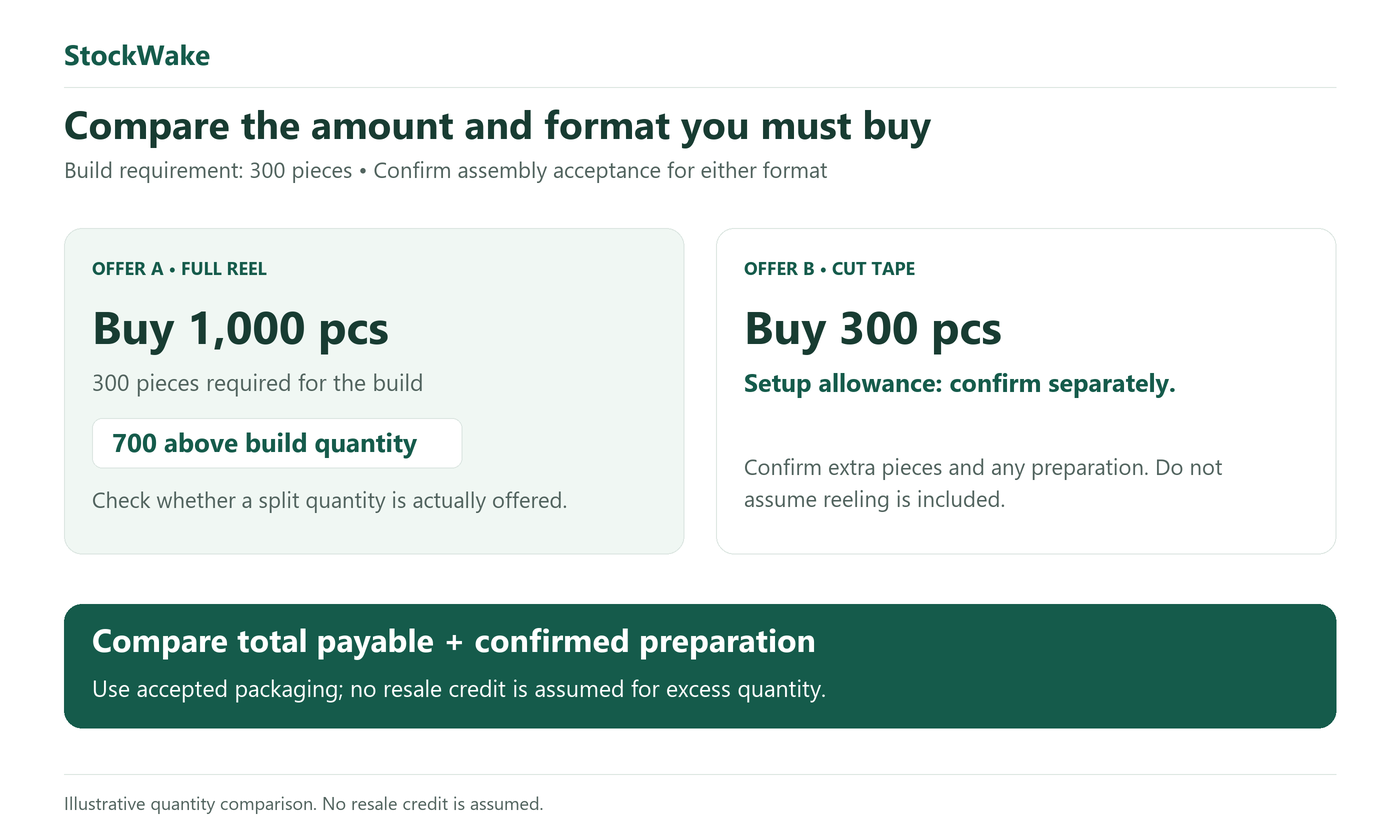
Illustrative quantity comparison for a 300-piece build: a 1,000-piece reel is 700 above the stated build quantity, before setup or process losses. A 300-piece cut-tape offer requires separate confirmation of setup allowance and preparation. Compare total payable and confirmed preparation without assuming resale credit.
Consider this illustrative comparison. It is not an actual stock offer:
- Build requirement: 300 pieces, before any separately confirmed setup allowance.
- Offer A: A full reel containing 1,000 pieces.
- Offer B: 300 pieces on cut tape.
The part number may match, but you are comparing different purchases. First establish whether the seller will divide Offer A. If not, the purchase is the whole reel, even though the current build needs only part of it.
| Comparison | Offer A: whole reel | Offer B: cut tape |
|---|---|---|
| Pieces you must purchase | 1,000 if no smaller release is offered | 300 as quoted |
| Quantity beyond the stated build need | 700 pieces | None before considering setup allowance |
| Amount to compare | Total payable for the whole reel, including any stated preparation charge | Total payable for the cut-tape quantity, including any stated preparation charge |
| Unresolved build condition | Required presentation and allowance still need assembly approval | Strip presentation and allowance still need assembly approval |
Do not multiply both unit prices by 300 and treat those results as equivalent order totals. Use the quantity you must actually buy and the price applicable to that release. Confirm whether preparation is included; do not assume that a quotation for fewer pieces includes custom reeling.
If you buy Offer A and allocate 300 pieces to this build, the remaining 700 are still purchased inventory. Do not deduct assumed resale proceeds as though they have already been recovered. A confirmed future requirement may help justify the larger purchase, but expected later use is different from a current production need. Include your applicable storage and handling obligations in that decision.
If both formats are accepted, compare total expenditure and the remaining inventory commitment. If only one format is approved, keep the other conditional while you seek a suitable presentation. If neither fits your build or purchasing limits, request an appropriate quantity and format instead of choosing solely by the lower unit price.
Carry the packaging decision into receiving
Retain the supplier's confirmation with the order line. Receiving and assembly staff should not have to reconstruct the agreed format from a quotation thread.
- Order record: State the delivered format, quantity per package and any restrictions on short strips or mixed lots.
- Receiving check: Reconcile package counts, labels and opened-package status with that record. Identify an unexplained difference instead of treating the same total count as sufficient.
- Assembly handoff: Pass on the accepted presentation and preparation requirements. Seek review if a different format arrives.
If packaging changes after quotation, ask whether quantity, identification or handling information also changes. Save the revised agreement against the same order line. Consider applicable handling requirements before opening protective packaging for another photograph; obtaining an image should not create an unreviewed packaging change.
Frequently asked questions
Does full reel mean factory sealed? No. You should treat the reel quantity and the condition of its protective packaging as separate facts. Ask whether the reel and any moisture-protective bag are unopened, opened or replaced, and request photographs supporting that description. An original label may describe the starting quantity rather than the remaining count. Confirm both the current quantity and packaging condition before you accept the offer.
Is cut tape suitable for automated assembly? It may be, but you should ask your assembly provider before ordering. Confirm acceptable strip lengths, tape continuity, leaders and trailers, and any setup allowance for your equipment and build. A cut-tape offer does not automatically include a custom reeling operation. If a different format is necessary, have the supplier confirm the format and quantity that will actually be delivered.
Is a partial reel the same as a custom reel? Not necessarily. A partial reel can be the remainder of an original reel, while a custom reel can result from a separate reeling operation. Ask your supplier which description applies and who handled the packaging. You should retain the original identification together with any new packaging record, then confirm the current quantity and whether the format meets your assembly requirements.
Can one reel include more than one lot? You should not assume either way from the reel's appearance. Ask the supplier to identify any combined lots or date-code groups and explain how their identities are retained. Then check whether your purchasing and assembly requirements permit that combination. If you require separate lots, state that requirement before ordering and have the delivered quantity and identification confirmed for each group.
What if the photograph and offered quantity disagree? Ask for a current quantity confirmation and an explanation before you purchase. An original label may show the starting quantity, while the offer describes the remaining pieces or a smaller quantity taken from it. Record those figures separately, request supporting evidence for the current count, and resolve any unexplained difference. Your order should state the quantity and packaging basis you have actually agreed.
Final Thoughts
Choose packaging against your build requirements and the purchase you must actually make. Confirm quantity, accepted presentation and any preparation charge before comparing totals. Keep excess inventory separate from the current build need, and resolve packaging changes before ordering. You can send StockWake a BOM or sourcing request that includes acceptable formats and quantity requirements, so the discussion starts with usable purchasing conditions alongside the part number.
Sources
- DigiKey: Packaging Types.
- DigiKey: Details about Digi-Reels.
- DigiKey: Pick and Digi-Reel Label Overview.
Editorial note: Prepared by StockWake using the named manufacturer and distributor sources. The comparison methods and checklists are editorial analysis; labeled hypothetical examples do not describe an actual order.