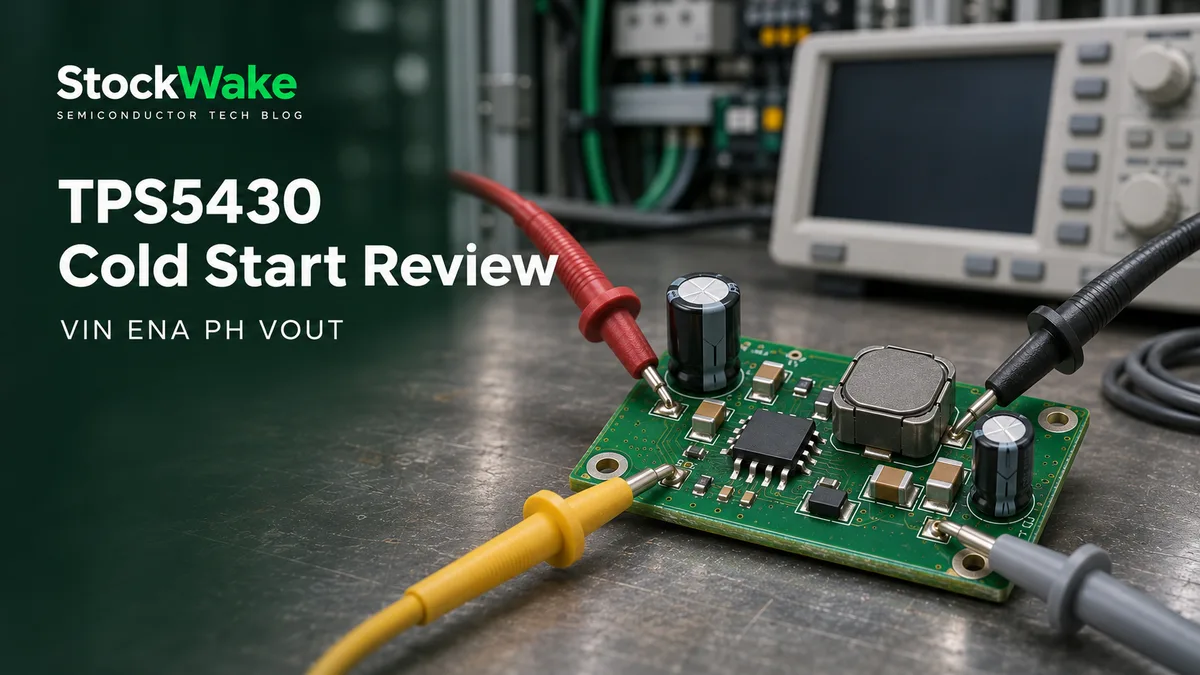
If a TPS5430 has no output at cold start, capture VIN, ENA, PH, and VOUT from the same attempt before deciding to replace the chip. A steady multimeter reading may miss a brief input or enable change. Compare the signals on a common timebase to separate an input problem, a disabled regulator, no switching, and switching that starts then stops. These observations guide the next check; they do not establish a root cause.
Define the Device and the Starting State
This guide covers the standard TPS5430 in a positive-output buck circuit. Do not blindly apply these checks to an inverting converter, a TPS5430-Q1, or a TPS5430-EP. Confirm the actual schematic, board revision, output setting, and complete ordering code first.
For example, the TPS5430DDAR is a standard orderable code in TI's package addendum. A package marking alone does not establish that code or its source history. Keep the label and BOM references with the board record.
Define what "cold start" means for this investigation. Record the off interval, measured starting voltages, ambient conditions, supply ramp, current limit, and connected load. Do not label an ENA restart with VIN already present as a complete input-power startup.
Capture Four Signals from the Same Attempt
Use a common time reference so your records show what happened first. If separate acquisitions are unavoidable, label them as separate attempts rather than combining them into one apparent event.
Have a qualified reviewer choose suitable probes, ratings, and reference points before applying power. PH is a switching node, not the regulated output.
Same-Attempt Startup Record
Signal | Record | Question It Answers |
|---|---|---|
VIN | Voltage at the IC input and its local ground, including the ramp and any dip | Did the input remain suitable when the board tried to start? |
ENA | Pin voltage relative to IC ground and the controlling circuit's state | Was an enable condition established and maintained? |
PH | Switching activity, first pulse, and any later interruption | Did switching begin, remain absent, or stop? |
VOUT | Initial voltage, rise, and any collapse, with the load state | Did the output build up and stay established? |
Retain the waveform files, channel labels, coupling, scales, probe settings, and trigger. A cropped picture with no shared timing can hide the input dip that preceded a disappearing output.
Check the TPS5430 Enable Pin and Startup Threshold Limits
VIN Must Clear the Input Gate
In TI's SLVS632L Rev L datasheet, the recommended TPS5430 input range is 5.5–36 V. The UVLO rising threshold is listed separately as 5.3 V typical and 5.5 V maximum. A typical threshold is not a promise that every single device will start at that voltage.
ENA Must Clear Its Own Gate
The TPS5430 enable pin (ENA) rising threshold is 1.3 V maximum; the falling threshold is 0.5 V minimum. TI describes ENA below 0.5 V as disabling switching and allows it to float through the internal pullup.
Check the actual control network. Do not assume ENA may be tied directly to VIN. ENA has a separate 7 V absolute maximum, and an absolute maximum is not an operating target. The listed slow-start time is 5.4–10 ms (8 ms typical); it is not an unconditional deadline from power connection to a valid board output.
Follow the Observed Sequence Before Blaming the Chip
Classify the trace before proposing a cause. A TPS5430 not starting at all and one that starts repeatedly are completely different observations.
Waveform Branches Before a Replacement Decision
Observed Sequence | Next Review | Limit of the Observation |
|---|---|---|
VIN dips or remains below the required input condition | Review the source, current limiting, connections, and input behavior under the stated load | A later steady VIN reading does not clear the startup input path |
VIN is suitable but ENA remains in the disabled state | Review the enable source, timing, and pin-level voltage | No output does not establish an IC failure |
VIN and ENA appear suitable but no PH switching is captured | Check acquisition coverage, connections, BOOT circuit, and feedback against the schematic | These are review candidates, not a diagnosed root cause |
PH switches, then stops or repeats while VOUT fails | Correlate input and enable changes; investigate load, output path, feedback, and applicable protection behavior | A burst pattern alone does not identify which condition caused it |
TI documents BOOT bias, output feedback, overcurrent, overvoltage, and thermal protection as separate functions. A stopped PH trace does not by itself prove thermal shutdown.
Freeze the Evidence Before Swapping Parts
Keep the original board identity, complete MPN, handling record, conditions, and unedited acquisitions. Changing the load, supply ramp, and device all at once prevents a clean comparison. If further evaluation is needed before a purchase decision, turn the remaining question into a specific inspection request.
FAQ
Why Can VIN Look Correct After a Failed Start?
The input may have dipped during the attempt and recovered after switching stopped. A later multimeter reading cannot show whether the input condition was maintained during that event.
What Should I Check on the TPS5430 Enable Pin?
Record the actual ENA voltage and control timing relative to IC ground. Use the current datasheet's separate rising and falling bounds. Do not assume its permitted voltage equals VIN.
Does No PH Switching Prove the TPS5430 Is Faulty?
No. First confirm that the acquisition actually covers the attempted start. The absent waveform is an observation, not a component verdict.
Is the TPS5430 Startup Threshold Always 1.06 V?
No. That number appears in the EVM guide's specific ENA-release example. Do not turn one example's voltage into a universal startup acceptance criterion.
Can One Passing Comparison Approve the Whole Lot?
Not by itself. Any lot decision needs the applicable acceptance basis and reviewer. Check the scope of the inspection or test report instead of extending a sample result beyond its coverage.
Make the Next Decision Traceable
Replace the device only within the approved investigation plan, without turning an unexplained board symptom into a claim about every part.