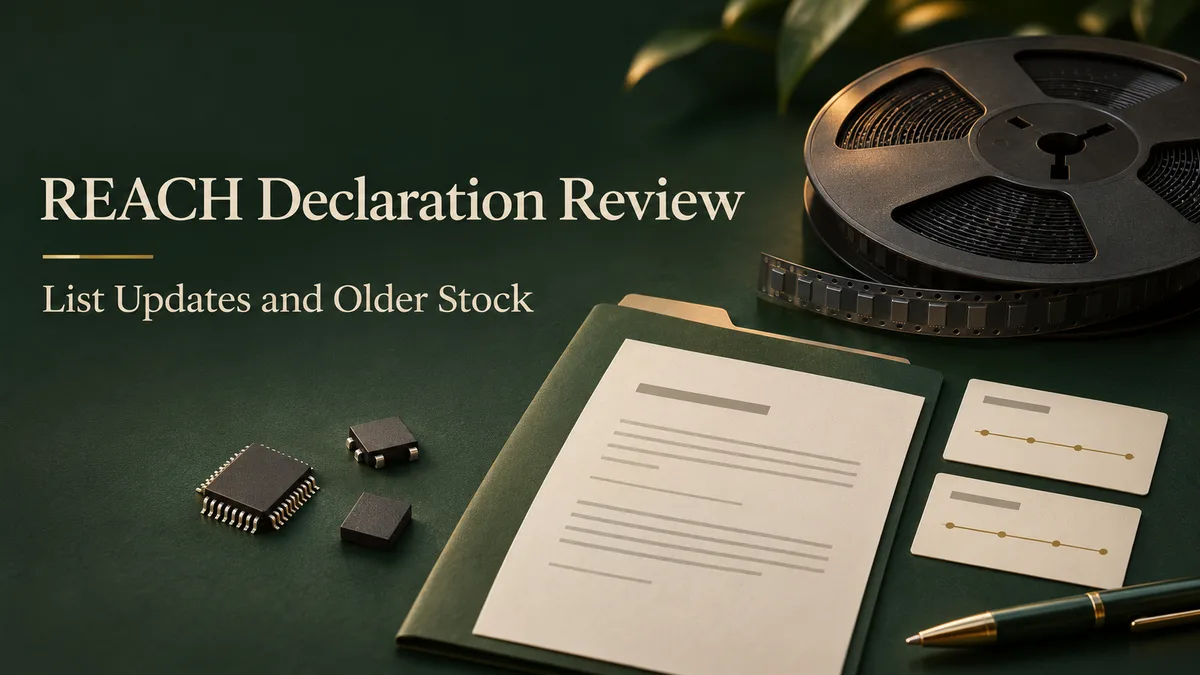
A Candidate List update does not, by itself, prove that an older REACH declaration is invalid or that the stock needs retesting. For a purchasing decision, check whether the evidence addresses the updated list and the material actually offered. Keep the historical declaration, identify the assessment basis, and ask the issuer to connect its findings to the older product. A newer issue date alone does not establish that connection.
Identify the Candidate List Change Under Review
Start with the update that triggered the question. Record the Candidate List version or publication date used in the existing declaration. Then identify the update your review needs to address. Keep an unresolved reference explicit rather than filling it with a remembered substance count. SVHC stands for substances of very high concern.
The immediate task is to establish what has been reassessed. In its environmental compliance FAQ, NXP describes investigating possible product inclusions after new SVHC additions, then updating its statement based on the findings. That is a manufacturer review process, not evidence of a universal declaration renewal interval.
Ask whether the issuer has assessed the additions relevant to your review. Missing evidence that the relevant additions were assessed leaves a gap. It does not establish that a substance is present in the stock.
Separate the Declaration Date From Its Assessment Basis
A document can be issued after the list version it discusses. Read both dates before calling it current. TI's REACH statement revision AP is revised February 6 2026, while its stated Candidate List basis is February 4 2026. These are dated examples from that document, not a claim that February is the latest list today.
| Date or Reference | Question It Answers | Limit of That Evidence |
|---|---|---|
| Declaration issue or revision date | When this document was issued or revised | Does not alone identify the assessed list |
| Candidate List basis | Which reference the assessment addresses | Does not alone identify the covered historical goods |
| Stock manufacturing period | When the offered goods were made | A date code alone does not establish composition |
| Material change effective date if applicable | Where an evidenced physical change applies | Cannot be invented from a reporting revision |
| Buyer review date | When the evidence was assessed for this decision | Does not change the manufacturer's document scope |
Keep these references separate in the review. For the broader document identity checks, use the existing material-declaration guide. Here, the added question is whether the list change leaves the older-stock assessment incomplete.
Connect the Updated Findings to the Older Stock
Request the Historical Product Scope
Ask the issuer whether its updated assessment includes the product and manufacturing period represented by the offer. Where a material revision or lot boundary matters, request the evidence that defines it. A broad statement may help, but its exclusions and qualifications still apply.
For example, NXP's February 4 2026 statement has explicit product-scope exclusions. Its current wording should not be extended to excluded hardware or to every historical item merely because the brand matches. The issuer needs to explain how the evidence applies to the goods under review.
Keep Unconfirmed Coverage Visible
Do not translate “same part number” into “same assessed material history.” Equally, do not assume an older manufacturing date means different chemistry. Use date and lot records to define the stock being reviewed, not to prove its composition. Request an applicability confirmation, an archived assessment, or supporting material information that addresses the specific uncertainty. A supplier forwarding the newest statement has supplied a document; it has not necessarily resolved its historical coverage.
Distinguish Reporting Updates From Physical Changes
A revised declaration may reflect new information about existing materials. It need not identify a physical change to the product. Keep those possibilities separate when explaining why two versions differ.
The historical section of NXP's dated REACH statement gives a useful example. It describes NMP reported as a raw-material ingredient for coatings associated with legacy Marvell WiFi and Bluetooth devices. NXP investigated with suppliers, confirmed the content did not remain as residue in affected materials, and updated reporting in January 2021. That note does not establish a manufacturing changeover date for a lot offered today.
If the explanation instead involves an actual material change, request its documented applicability. Do not infer a change notice or a cutoff date from the declaration revision. If the issuer cannot establish which history applies, keep that question open.
Record the Purchasing Decision Against the Evidence
Use a short change-impact record rather than replacing the old declaration with a new file and losing the history. The record should show the trigger, the issuer's findings, the goods covered, and the remaining question.
| Evidence Position | Next Review Step | Decision Boundary |
|---|---|---|
| Updated list addressed and older-stock scope supported | Assess the findings against the purchase requirements | Record the covered goods and conditions |
| Updated assessment available but historical coverage unclear | Request issuer evidence linking it to the offered goods | Keep the REACH coverage question unresolved |
| Only the earlier list basis is supported | Request an assessment of the relevant additions | Retain the old declaration as historical evidence |
| Customer requires a particular renewal or evidence format | Check the stated requirement separately | Do not turn that requirement into a universal expiry rule |
Let the responsible reviewer decide whether the evidence meets the stated purchasing requirements. Keep the roles of declarations and test reports separate. If more investigation or testing is proposed, define the question it must answer and the goods it represents. Repeating a test without that scope does not resolve an unclear declaration.
FAQ
Does a REACH Declaration Expire When the Candidate List Changes?
Do not decide from the update alone. An earlier declaration records its stated assessment basis. Check whether the changed list has been addressed for the goods being purchased, and whether issuer conditions or the customer's requirements call for further evidence.
Does a Recent Declaration Cover Stock Made Years Earlier?
Not automatically. Ask whether its product scope and assessment include the offered historical goods. The issue date is not an applicability statement. Relevant material-history or manufacturing-period limits need to be resolved rather than inferred from the current part number.
Must All Older Components Be Retested After an SVHC Update?
A list update alone does not establish that requirement for every item. Start with the issuer's assessment and available material evidence. If a reviewer requires testing, define the substance question, sample scope, and acceptance requirements before treating a result as relevant to the purchase.
Does an Updated Material Report Prove the Product Changed?
No. Reporting can change after an investigation of the existing material. A physical change needs its own evidence and applicability. Do not assign a manufacturing cutoff date unless the issuer's information supports one.
What Should Stay With the Purchasing Review?
Keep the earlier declaration, the update being reviewed, the issuer's findings, and the evidence connecting those findings to the offered goods. Record the reviewer's decision and any limits. Keep unanswered questions visible instead of treating a newer file as approval.
Close the Evidence Gap Before Closing the Review
The useful result is a supported link between the updated assessment and the older stock. Keep the historical declaration, obtain the missing applicability evidence, and document the decision within that scope. When the link remains unconfirmed, name the missing evidence and keep that part of the purchasing review open.