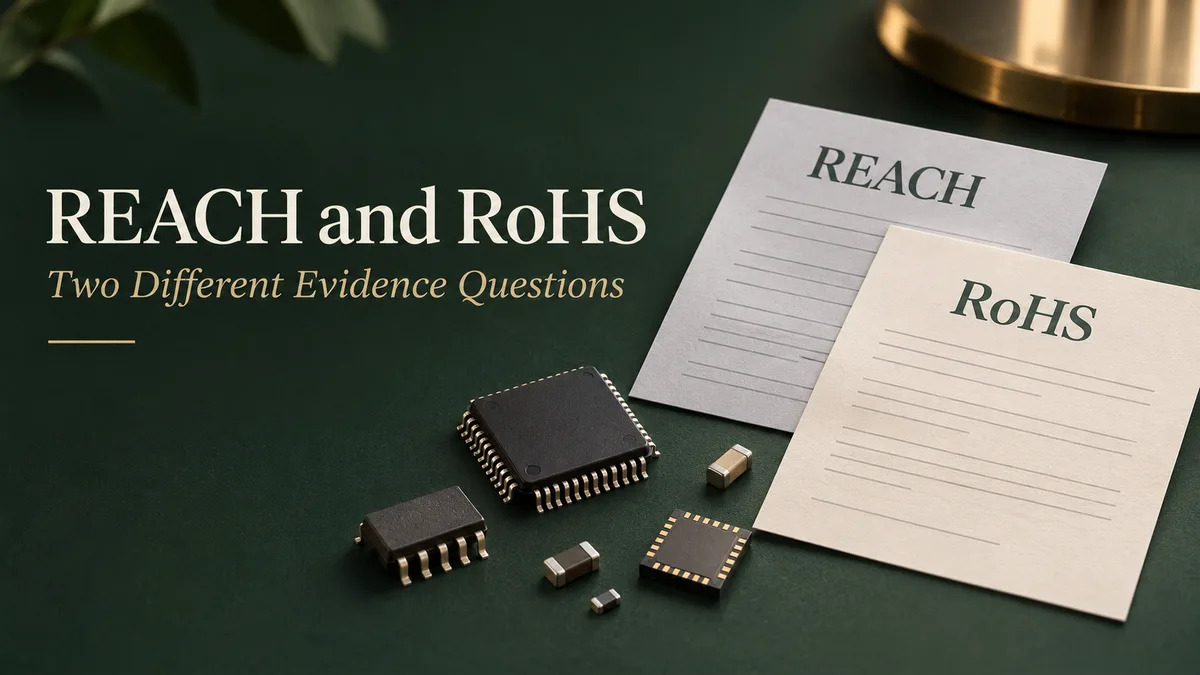
REACH and RoHS compliance answer different questions when you buy electronic components. RoHS addresses restricted substances in electrical and electronic equipment. REACH covers a broader chemical regulatory system, including restrictions and substance information. A RoHS statement therefore cannot answer every REACH question, or vice versa. Read the claims separately, even when one document contains both. Then check what the manufacturer actually says about the proposed component before using either statement in a purchase decision.
Separate the Two Questions Before Comparing Documents
The Regulatory Scope Comes Before the File Name
The European Commission describes RoHS as restricting certain hazardous substances in electrical and electronic equipment. Its REACH overview describes registration, evaluation, authorisation and restriction of chemicals. REACH also includes communication of substance information. Reducing the comparison to two lists of chemicals misses those different purposes. SVHC stands for substances of very high concern.
For a component buyer, the useful question is what each statement establishes for the requested part and intended use. Do not begin by counting certificates. A document heading, a supplier spreadsheet column or a green icon is only an entry point. The underlying claim and its limits determine what you can record.
| Comparison Point | RoHS Review | REACH Review |
|---|---|---|
| Main scope | Restricted substances in electrical and electronic equipment | A broader system governing chemicals and related information |
| Component evidence | Declared substance status and any claimed exemption | The stated restriction and SVHC information coverage |
| Common reading error | Treating an exemption as an absence of the substance | Treating an SVHC information finding as an automatic prohibition |
| Purchasing output | A supported RoHS conclusion with its conditions | A supported REACH conclusion with its own scope |
These are separate review questions, not a universal legal document list. The applicable product scope, market, role and use still matter. This comparison does not determine every obligation for a finished product or every use of a component.
Interpret Status Labels in the Manufacturer System
A Qualified Status Can Carry Useful Information
Texas Instruments provides a practical example. Its environmental information page directs users to product-specific RoHS, REACH and Green status and material information. Those fields are distinct. A favourable result in one field does not fill in the others.
The following meanings are specific to the TI statements identified below. They are not a standard legend for every manufacturer, and they do not report the status of any component offered by StockWake.
| TI Field | Meaning in the Cited Statement | Reading Boundary |
|---|---|---|
| RoHS Yes | The stated restricted-substance limits are met | Read the separate REACH field |
| RoHS Exempt | An applicable RoHS exemption is claimed | Do not record the exempt substance as absent |
| REACH Yes | The stated SVHC and Annex XVII conditions are met | Keep the statement scope and product identity |
| REACH Affected | An SVHC information condition is identified | This is different from the restricted-use finding below |
| REACH No | An Annex XVII substance is outside an allowed application | Escalate the specific restriction and use question |
TI's RoHS statement Rev T, revised December 2025, explains its Yes and Exempt designations. Its REACH articles statement Rev AP, revised February 6, 2026, distinguishes Yes, Affected and No. Preserve those qualifications rather than translating every status into a single pass or fail cell.
For another manufacturer, obtain that issuer's definitions. Similar wording is not evidence that the assessment scope or classification is identical. An exemption also needs review for the actual use; the label alone does not settle its applicability.
Assess Each Claim Even When the Statement Is Combined
One File Can Contain Two Separate Conclusions
A combined declaration may address both subjects. The purchasing task is to find the actual RoHS claim and the actual REACH claim within it. Two headings do not establish complete coverage, and two separate PDFs do not cure a missing product or scope connection.
- Identify the conclusion the request needs under each subject.
- Locate the wording and supporting product information for that conclusion.
- Keep any exemption, restriction, list basis or qualification with the relevant claim.
- Record an unanswered question separately instead of copying a result from the other field.
Use the existing component material declaration review for the basic document checks. Here, the added step is to avoid letting an apparently complete file hide a gap between the two claims.
If a supplier sends a test report instead, determine what the reported work actually covers. The distinction between a conformity statement and an inspection or test report matters. A result for selected substances in identified samples does not, by itself, answer every regulatory or product-scope question.
Carry the Qualifications Into the Purchasing Decision
Keep the Unresolved Question Visible
Consider a hypothetical quotation carrying a RoHS Exempt entry and a REACH Affected entry. Do not assume they contradict each other. Read each issuer-defined status, identify the supporting product record, and ask the responsible reviewer to resolve the exemption and information requirements that matter to the intended use. This example is a reading exercise, not a status claim for a particular part.
Where the supplier proposes another ordering code, retain the environmental requirements in the review of the proposed BOM alternative. A substitute needs its own applicable evidence. Approval of the original code does not automatically extend to the candidate.
The resulting record should show two conclusions and the evidence supporting each. One may be resolved while the other remains open. Name that remaining question precisely, such as missing SVHC coverage or an exemption that has not been checked for the intended use.
FAQ
Does a RoHS Statement Also Prove REACH Compliance?
No. It supports the RoHS claim within its stated scope. Look for a separate REACH conclusion and its basis, whether it appears in the same file or another record. Do not infer it from a RoHS heading or logo.
Must a Supplier Always Send Two Separate PDFs?
Do not use file count as the acceptance rule. A combined statement may contain distinct claims for both subjects. Check those claims against the applicable requirements and purchasing request. This article does not establish a universal legal requirement for two physical documents.
Does TI REACH Affected Mean the Component Is Banned?
The cited TI statement uses Affected for an SVHC information condition. It distinguishes that from its No designation for an Annex XVII restricted-use finding. Read the applicable substance and use conditions; do not turn the label into an unconditional approval or prohibition.
Can a Green or Lead Free Label Replace Either Review?
No. Establish what that issuer means by the label and what it covers. TI presents Green, RoHS and REACH as separate product fields. A label about one characteristic should not be expanded into a conclusion about another requirement.
Can One Chemical Test Close Every Compliance Question?
Only draw conclusions supported by its substance coverage, samples, method and conditions. A test result is not a substitute for missing scope or applicability information. Decide which question the report answers before using it alongside a manufacturer statement.
Keep Two Supported Conclusions
Read REACH and RoHS as distinct evidence questions. Interpret qualified statuses in the issuer's own system, preserve the conditions, and record what remains unresolved. The useful purchasing result is a clear, supported conclusion for each requirement, rather than a file count or an unqualified green tick.